Race Report: Frankfurt Marathon

First and foremost, I apologize for neglecting my blog for much of 2017. That’s about to change! Second, it has been an incredible year. I am so humbled and proud of the hard work my roster have brought to the table. It’s an honor to do what I do every day.

In June 2017, I was forced to take 4 weeks off from running. With it being my first injury of any kind since 2012, I consider myself lucky. I was allowed to run on an Alter-G at a fraction of my weight while working on recovery and rehab for a heel spur and plantar fasciitis. With my goal marathon on October 29th, the clock was ticking. Once cleared to run outside, I had about 15 weeks until race day. That’s definitely not ideal for building fitness for a marathon PR, but I decided I’d do what I could with the time I had. Despite a few bumps along the way, training went smoothly and I felt my fitness return pretty quickly.

Fast forward 15 weeks, and I was hopping a flight to Frankfurt, Germany. I’d picked Frankfurt Marathon for a few reasons. It’s incredibly flat/fast, weather is usually ideal, and it’s well organized. It was also an excuse to go explore a new city! Ironically, the weather wasn’t looking awesome as I was en route to the airport – winds with heavy gusts. I knew I’d have to rethink my strategy for the conditions, but decided not to panic but to accept the weather and make smart choices. I still really wanted that 2:59, but had also accepted that the weather would be a variable I cannot ignore.

Race morning I was relatively calm. I ate a banana and a donut, had some coffee, and headed to the starting line. The temperature was cool. But the wind was picking up here and there. My coral was mostly men. Not surprising, as marathons in Europe are a heavily male dominated sport. I could see the 2:59 pacers, and my plan was to try and tuck in behind them and draft behind them in the wind if and when it would be an issue. The pace group took off a little fast compared to my watch, and I opted to listen to my watch and be perhaps a little conservative than risk going out too hard. I settled into my effort, and the first 10 miles felt incredibly smooth.

The big mistake I made: my watch was in miles, the course was in kilometers. I grabbed a pace bracelet and stupidly got it in miles and not kilometers (hello, jet lag brain!), so I didn’t have a way to verify on the course if my watch was correct or not. It turns out I was a little behind pace, setting me up for a nice little negative split for the second half if the predicted winds would be at my back. A lot can happen in the marathon, and I told myself to relax and be patient. Head wind gusts became a factor around miles 15-17 off and on. Nothing terrible, but also not ideal. Otherwise, everything felt good. My foot felt 100%. My body felt solid. My hydration was solid. I was feeling smooth out there and optimistic. The tail winds predicted never really happened. Instead, air was still for a little while. Then as we neared the city again, head and cross winds began to pick up. With no pace group near me (the 2:59 pacers had slowly disappeared in front of me), I tried to tuck in behind every man possible and draft. I could feel my effort increasing as my paces began to slip.

With a 5K to go, Chris was there yelling at me to push for the 5K. I clearly remember thinking “F*ck!!! A whole 5K?!?” as I did the math and knew breaking 3 hours was definitely not in the cards and now a PR was in jeopardy. In the final 5K, for the first time all morning, I was being knocked sideways by strong gusts of wind. I was exhausted, over it, and trying to simply focus on the finish line. Despite my effort, I could not will myself to lock those 6:50s in my body at that point.

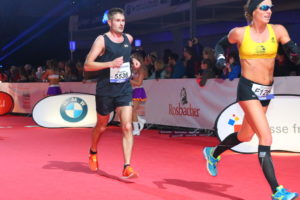
The finish line of Frankfurt Marathon is really spectacular. It finishes inside an arena with thousands of fans screaming. When my watch went off at 26 miles, I knew my watch was off, and that it was going to come down to seconds for a PR. I stopped looking at my watch, and told myself to use every ounce of energy towards the push to the finish line.

I crossed the finish line in 3:03:21. A 9 second PR from last year’s Berlin Marathon, and good enough for 3rd American Woman. Am I happy with the finish time? No. Absolutely not. I’ve never been so disappointed by a PR in my life. But I know I ran a smart race. I know I trained wisely. I made thousands of smart choices day after day. Looking back, there are things I can definitely do to improve as a marathoner. Weather is the wild card. But I can do more negative split long runs, or longer long runs in the future. I’m eager to learn and make adjustments to improve. In the 18 marathons I’ve finished, I’ve learned something new about myself as a human and a runner. It’s important to accept that we are all unique, and to honestly learn from strengths and weaknesses.
I would absolutely recommend Frankfurt Marathon to anyone looking for a flat and fast marathon. It was a pretty amazing day. And the days following the marathon were really fun. Food and drink is everywhere. If you enjoy baked goods and beer, Germany is for you. Frankfurt is an incredibly friendly city to travelers from all over the globe.

A few tips: I highly recommend spending the money on direct flights while traveling for an international marathon. Between time zones, jet lag, change in altitude, etc – the extra money is worth it. I also recommend booking a hotel that’s in a central location and walking distance to the start/finish line. The hotel location, comfort of the room, and so on are all variables to consider for race weekend. Do what you can to run your best. Stick to bottled water if somewhere new, and prepare race morning food the day before.

I am now taking a little off season. Legs and feet feel decent and were a little sore and tired for a couple days post-race. Even when feeling good, injury risk is high after racing a marathon. I’m allowing my body to fully recover, mentally process what I can work on, and think about my 2018 goals. I am excited for my athletes racing NYC Marathon and Philly Marathon. The marathon journey is always filled with highs and lows. Perhaps what makes the distance so incredible to me is that there are never any guarantees. It’s a race distance that can empower and crush. It just depends on the day.


The Twelve Myths of Fitness – Day 12: You should eat 5 meals per day

The theory that there’s a magic number of meals per day for weight loss, muscle gain, etc. is something doctors, nutritionists and celebrities have varying opinions about. While you’d think we’d take an educated and certified professional’s advice over a celebrity, that sadly isn’t always the case. The media and we as a culture often admire and adore folks in the limelight, and give them perhaps far more credibility than we should. And so many myths becomes “facts” in some warped way.

The advice that 5 small meals per day will lead to weight loss is somewhat both a myth and sometimes a fact. When we go long periods of time without eating, it can be common to feel a dip in energy, mood and focus. Maintaining somewhat consistent blood sugar can prevent dips and spikes in energy. So it makes sense that continuously fueling your body at a slow burn would keep your energy, metabolism, and blood sugar all happy and in check. Here’s the danger with that: it can be easy to overeat and consume far more calories if you are actually eating 5 “meals.” And if you are eating around the clock, your body will be using the fuel in your stomach for energy, not the body fat you are hoping to lose. Remember that insulin plays in a big role in how we use what we put in our mouths – and when.

The best way to eat for weight loss, maintaining weight, and feeling fueled tends to trend with the concept of 3 meals per day, and some snacks throughout the day. Now, snacks of donuts or candy probably aren’t what doctors are recommending. Instead, something nutritionally dense, and in the 100-300 calorie range. Think of a piece of fruit, a container of greek yogurt, sliced veggies with hummus – that kind of thing. Another thing to keep in mind is portion size for the meals. In general, portions are way too big in America. So that means we are consuming more calories at a sitting than necessary but assuming that’s “normal.”

It’s also important to remember that we are all different. While our bodies are all quite similar, we have different variables. Working different hours, sleep, age, activity level. Some of us are naturally grazers. Others need the ritual of sitting down to a “real meal” in order to feel satisfied. While some people like to drink their calories (smoothie, shake, etc.) others feel the need to chew their food. It is common that when hangry, we will reach for the most available and desirable item. This scenario rarely leads to good choices. So preventing that hangry state from occurring can help.

So while there may be no magic number of meals for us across the boards, a balance in macros throughout the day and at each meal can help. And if you are consuming the amount of calories needed, weight gain won’t be an issue. If you are looking to lose weight, stay away from temptations, and keep your macros in check.

The Twelve Myths of Fitness – Day 9: Your body will fall apart at 30 years old

Unless you find the fountain of youth, aging is pretty much inevitable. I say “pretty much” because we all age differently. Some of that is due to genetics. And some is due to lifestyle. I remember when I was in my 20s, I was told by 30-something year olds that once I hit 30, everything would go to shit. I’d feel different, and staying in shape would be tough. I never understood why a number would matter so much. Why not 29? Or 34? Why was 30 this magical age where we go from youthful, calorie burning, fit and hangover-free kiddos to old, tired, fat, hangover-fighting people, remembering better days? Having now spent a few years in the “over 30” category, I am now warned and cautioned relatively frequently that my days of being fit, improving as a runner, and eating pizzas and pints of ice cream will catch up with me any day now. So today’s blog is about that magic number, and what’s true and not so true about the “over 30” theory.

Genetics are something we cannot control. If you can look into the physical, mental and emotional aging of your siblings, parents, cousins, grandparents and so on – there are some clues for what you may be able to expect. Some traits, diseases, weaknesses and so on are genetic. Others are brought on by other factors. So your mother isn’t necessarily a clear example of what you will look like, feel like, and be capable of when you are her age. Though you can expect some similarities. Hormone levels play a huge role in how we age – from mood, energy level and sex drive to muscle density, bone density, and so on. Men and women naturally experience a dip in hormones at some point in their life. The dip or change in hormones, combined with perhaps less activity can naturally lead to weight gain, fatigue, and change in mood.

The cool thing is that while we can’t control our genetics, we are pretty darn in control about our choices we make in our lives. Our happiness, quality of life, stress level, sleep, hydration, activity, nutrition choices – all greatly factor into how we age. And while there are certainly things that cannot be helped, like work deadlines or sick children, choosing to eat well and exercise regularly can help many of us age in a slightly more graceful manner. Here’s some helpful info on exercise and being active, food and lifestyle adjustments you can try to make.

Now, if you are an athlete, your body may at some point need extra recovery time and there will be a time those personal records tend to stop happening. But lifting heavy can greatly help our bodies age, and runners can certainly achieve very impressive things after 30, 40, 50, or 60. I’ve had athletes in their 50s and 60s achieve things many folks in their 20s can only dream of doing. And personally, I am faster at almost every race distance in my 30s than I was in my 20s. And I am definitely in better shape. Other runners will peak in their early 20s, but those are usually folks who were running and competing in high school, and quite possibly now feel the consequences of pushing a body still growing and developing.

While we cannot fight Father Time, there are things we can do to stay as active, energetic and strong as possible. So remember the next time you don’t feel like going to the gym or eating a big bowl of greens, that doing things that are good for you are always worth it. This article from Harvard Medical School breaks down how we age when exercising versus not. It’s a good reminder that some changes as we age we cannot really feel, but those changes are important.

The Twelve Myths of Fitness – Day 8: Cleanses are good for you

The cleanse/juicing/toxin myth is a topic that fuels some strong opinions and emotions. Why this topic fuels such passion (and bad research and advice) has surprised me over the years. It certainly is a topic many talk shows (hello, Dr. Oz) spend lots of time promoting. And while “rebooting” your nutrition for a day or a week usually isn’t a bad thing, there’s little evidence there’s any good to come from extreme measures.

We’ve all been there – we get to a breaking point where nutrition has spiraled out of control. It can be as simple as realizing you’ve consumed french fries every day for the last week or month, or have been seriously skimping on your fruit and veggie consumption. Or maybe you have gotten into a habit of skipping breakfast but feasting on the office baked goods midmorning, and you want to break that cycle. Often we want to do something epic, something to shake things up and to make the change seem “real.” Perhaps that’s why extreme measures like cleanses are so popular.

To understand the whole theory behind cleanses, you need to understand toxins. Most cleanses are advertised and credited with flushing our bodies of toxins. Toxins sound bad, right? Like, ewe. So without doing any research, you’d probably be on board and eager to “cleanse” yourself. But here’s the thing, if you spend 5 minutes actually reading something medically and scientifically backed up, you’ll quickly understand why the whole cleanse/toxin thing is complete BS and simply a great way for the health industry to make a fortune. The toxins that naturally exist in our bodies are processed by our liver and colon. And they do a pretty awesome job. In fact, unless you have an extreme medical condition, or were somehow poisoned, our bodies are equipped to handle and process everything in an extremely effective manner. So the whole idea of fasting or a cleanse of some sort is silly. Still wanting to read more on toxins? Here’s a good read.

Now if you are still interesting in juicing or fasting, and understand that there’s no guaranteed benefits, keep in mind that these extreme measures are not sustainable. And while you will drop weight (you’ll lose the weight of food in your stomach, for one thing), you may also end up losing muscle mass and no fat. So the number on the scale will go down, but is that the end game? Here’s an interesting view on juicing, fasting and some recent research.

So if you now understand toxins, fasting and cleanses, and want to overhaul your habits or nutritional choices, try to eliminate processed foods for a week. You’ll reset your relationship with food, and be very aware of the choices you are making. You will also never risk being deficient in your macro’s – so your blood sugar and energy levels won’t be all over the place, and you shouldn’t feel starved.

The Twelve Myths of Fitness – Day 6: I don’t need sleep

I don’t know how, where or when, but at some point we as a culture have decided that sleep is a luxury. That if you don’t sleep much, you are badass, stronger or work harder than the person in the office next to you or on the race course. Somehow sleep has a stigma that’s bad. Sleeping makes us lazy. We should be working more. Doing more. Socializing more. Sleep should be last priority.

Well, that’s wrong. Really, really wrong. Sleep is incredibly important and necessary for humans for many different reasons. It’s good for us. We are usually healthier, happier, stronger, and better at pretty much everything when rested. We should prioritize sleep with eating good food, hydrating, and exercise. Statistically, people who don’t sleep much or well are heavier, less focused, and less happy. Some jobs require long hours, or perhaps you have small children who wake up early. There are certainly many challenges for navigating how to prioritize sleep. But you may find you are more productive at work or have more energy or patience as a parent if you get some quality zzz’s. You will probably also consume less calories (usually snacks) if you get in 7-9 hours of sleep. Still making excuses for why your 4-5 hours per night is enough? Here’s a study from Harvard Med that should hopefully convince you to at least try to prioritize sleep a bit more.

I often stress for my athletes the important of rest days. The adaption to the training happens when we rest and recover, not while we are actually training. Skipping out on rest can have consequences, or simply prevent you from maxing out all the benefits of your training. Sleep is the best form of rest/recovery. If a runner has to choose between sleep and a run, I will sometimes suggest they opt for sleep. It’s usually better to train less but have better quality workouts than to be dragging your tired butt through too much. Here’s a helpful article on sleep, running, and general health.

At the end of the day, everything is about balance. Just try to remember that sleep, food, hydration and exercise are necessary for a happy and healthy life.