Frigid Weather? Tips for Training

conditions1Winter training can be tough. It’s dark, cold, and icy. Some Winters are easier than others. Last Winter was a real doozy, and this Winter is shaping up to be pretty darn challenging too. As a coach, I am constantly checking the forecast. I keep hoping I’ll see a week where we break out of the single digits or teens for the low, but week after week my hopes are crushed. I keep thinking we need to have a “warm spell” here sometime soon where we stay above freezing or at least around freezing for a week. No luck. And add the wind chill to some days, and it’s enough to feel completely defeated.

Runners, I hear you. At times I’ll say “suck it up.” After all, I didn’t force any of you to sign up for a Spring Marathon, or to set training goals during the Winter. If you want it, you need to work for it. However, I also can totally sympathize. When it is truly painful to be out there day after day, it’s easy to lose focus. Especially if you are battling icy conditions and constantly moving your training to accommodate the most recent storm.

So what can you do? I have a few tips that may help you power through the next few weeks. And hopefully at some point we’ll get a break.

  • You cannot change the weather, so don’t fight it. If you can move your training around bad weather, do so. If you cannot, get creative.
  • Running in extreme cold, snow and ice can actually be fun – as long as you are safe and keep your time out there to a minimum. In ice or snow, wear YakTrax and/or be careful. Abandon any pace goals and simply enjoy your run. In extreme cold, be mindful of how long you are out there and if body parts go numb or become painful.
  • Take your training inside. Perhaps you can swap out a run for a cross training day, or run intervals on a treadmill.
  • Avoid routes that are not cleared. In Winter conditions, some side walks, roads and running paths are commonly cleared, while others are last priority.
  • Be aware of wind chill, and stay away from large bodies of water or exposed routes. Protected routes from the wind will be warmer than routes out in the open or along rivers.
  • If you schedule allows it, run at the warmest time of the day. Even if it’s bitter cold, some sunshine can lighten your spirits and make it easier to see any ice ahead.
  • Refuel with something warm. I’m a fan of hot chocolate, or hot tea with a snack. Drinking cold water will only make you feel colder.
  • Avoid cotton at all cost. I’m am totally a fan of being a runner on a budget, but running in cotton during Winter is a major n0-no.
  • Get out of wet running gear and into something warm and dry or a hot shower ASAP.
  • Make your cold miles more enjoyable by running with a buddy or listening to music. You probably know other dedicated Winter warriors.
  • Don’t panic if your training gets slightly sidelined. If you need to swap in a rest day or cross training day for your “easy” runs, it’s not a huge deal. Focus on accomplishing your “quality runs” and consider that a success.
  • Remind yourself that at some point, weather will improve. Take it a day or a week at a time. Try not to despair because April seems so far away.
  • The odds are that other runners are struggling too. You are not alone. But the ones with big goals are digging deep and getting their miles done – one way or another. When you line up next to them for your race, they will have the edge. Either accept your modified training, or dig deep and be that person on the starting line with the edge.

Long Run, Dress Rehearsal

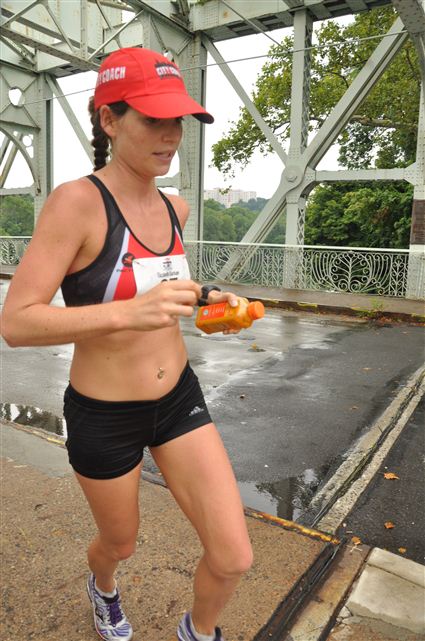
Over 30 miles into an Ultra Marathon in July 2012.

Over 30 miles into an Ultra Marathon in July 2012.

The long run. Often intimidating. Rarely easy. It’s the keystone to training for a marathon or half marathon. It’s also the run most folks training get wrong. Here are some things you can do to better your long run, your overall training, and the reasons why you should handle your long runs certain ways.

  • Think of your long runs as dress rehearsals for race day. This means you should practice eating dinner and breakfast the way you would before your race. it also means you should plan mid-run fueling as you would for race day. If you decide to “wing it” on race day, you are foolish. You have weekly long runs between now and race day. Use them as practice.
  • Don’t be scared of bombing a long run. If something goes wrong, LEARN from it. Perhaps you will need to cut the run short due to dehydration, chafing, or take a detour or a bathroom break. Or perhaps you need a walking/stretching break. Or you lose your mental focus and cannot get it back. IT’S OKAY. Figure out why these things are happening, and then we can fix them and never make those mistakes again. A bad long run isn’t a bad thing if you can learn from it.
  • Test out your fueling options. Some folks can take any kind of nutrition on the run and feel great. Other’s find almost every endurance fuel out there leads them to racing for the bathroom. There are dozens of fueling options. Find what feels best for you. Do you love caffeine GU? Do you need to avoid caffeine at all cost? Do you love your nutrition in liquid-form like Gatorade? What kind of Gatorade? Again, the long runs are rehearsals.
  • Take your pace easier than race day on your long runs. This is a hard concept for many runners planning for a marathon. The logic is often that you want to run at marathon goal pace so you know you can. Let go of that ideal. In fact, plan to run most long runs at marathon goal pace PLUS :15-45 seconds PER MILE. Why? Well here’s the short answer: to reduce injury risk. Think about it – when you finally run your 26.2 mile journey, it will be after a taper and you will plan to take at least a week off from running post-marathon. So HOW can you expect to run a 20-miler at your marathon pace and be recovered to run your speed workout a few days later? You cannot. Well you can, but your risk of injury is stupid high. Plus, if you are running speed workouts, running a “fast” long run has no real benefit. If you are sticking to a plan that includes speed workout and easy long runs, the combination will have you prepared for marathon day. I swear. I have yet to meet a coach who recommends you run your long runs at your goal race pace.
  • There are a few times when progressive long runs are beneficial. These should be handled with caution and are only ideal for experienced marathoners. Progressive long runs can vary in formula, but always end with finishing the long run faster than you started. Some will end with the runner finishing the final miles at marathon goal pace. Again, only for the experienced marathoner and with the advice of a coach.
  • Long runs are about time on your feet more than pace.
  • Regardless of pace, cap long runs at 2:30-3 hours. Reason being, injury risk goes up as the hours pile up. Again, totally understandable that a runner aiming for a 4 hour marathon wants to clock long runs of 4 hours, but hang in there. Instead, cap long runs at 2:30-3 hours and perhaps go for a second run within the weekend, perhaps within 24-36 hours – giving your legs the experience of running on tired legs but with the benefit of some recovery.
  • Long runs also give you the opportunity to practice recovery. Take the opportunity to figure out how you feel, what you need to eat and drink, and how your body reacts to the stress of the long run. Some runners are nauseous for hours post-run, while other runners want to eat everything in sight. Some runners have a hard time stretching, foam rolling and taking care of themselves, others are on it like rock stars. We can always make improvements, so budget time to handle yourself as needed after you clock that big run.
  • The long run is also a rehearsal for what to wear on race day. While seasons may change in the course of your training, try to wear what you may want to race in for some of those final long runs. Weather should be pretty accurate, as should your size and how clothes will fit you. Take note of any problem areas with chafing, and if you simply feel good or bad in what you wear.
  • If the long run is mentally intimidating, break it up into smaller sections. Taking on a 20-miler can seem like the worst thing ever, but 4 5-milers, refueling with GU every 5 miles suddenly doesn’t sound so hard. Remember that some miles will feel better than others, and often those middle miles are the hardest to grind through. Once you see mile 17 of 20, the light at the end of the tunnel is in sight.

Lastly, be sure to write down or remember what worked and what didn’t. That information can be priceless. How long did you eat before your run? Were you hydrated enough? How much sleep did you get? What fuel did you use and what was the outcome? Do you love or hate a certain training route? Were there mental roadblocks and what tricks got you past them? These are all clues that can lead you towards a successful marathon.

Accessing you mental toughness

635204708462443579It’s interesting to see and hear what my clients succeed and struggle with, and how that relates to my own struggles as an athlete. One thing a few athletes voiced struggling with in 2014 was mental toughness, which is a topic many of us know all too well. I’ve been thinking about my own relationship with it, and think I may have some ideas, tips and experiences that may help you and your running goals – especially in the marathon.

We are all incredibly strong. Sure, we have varying degrees of the tough stuff, but very few people are truly weak. However many people perceive themselves that way. The good news is that we can always change how we handle those hard moments and our perception. In running, clocking long miles like a marathon tend to really test our mental toughness. Mentally, I think anyone can get through a 5K. I can talk myself into doing anything painful or taxing for 15-25 minutes. Mentally, I’ve got that. That doesn’t mean I won’t hurt, fight towards the finish line and feel mentally spent at the end – because all of those things will definitely happen. But mentally I can always get myself around a 5K. A marathon is a whole different game. And here’s where we get personal:

I am going to assume that every poor soul taking the time to read my blog as experienced some form of hardship in their lives – maybe many. I’m talking the dark, ugly, painful shit. Divorce, loss of a loved one, being bullied, fighting substance abuse, physical setbacks, being mentally or physically abused, experiencing a horrific trauma and suffering from PTSD, rising above prejudices, or simply being told your entire life that you were weak. If you haven’t experienced any of that, you are extremely lucky and should probably start buying lottery tickets. For the rest of us, we have all had to cope with that crap at some point or another, most likely multiple times. Hopefully you have all processed these things in a healthy way. If you haven’t, talk to someone. Anyway, I’m not a therapist, but I do know the power of rising above bad experiences. If you are planning to run or race a marathon, or a distance that is new and/or terrifying to you, use those bad experiences. Why? Because you have forged your way through them and are here today and ready to run. That takes guts. And a hell of a strong brain. That strength is your ace in the marathon.

Personally, I’ll freely admit my triggers. For my first marathon, I used the determination to prove to myself and every girl who bullied me in high school that I was a strong fighter, and a Boston Qualifier. I wanted to prove them wrong. I wanted to prove to myself I could survive an ugly divorce, a sexual assault, and a suicide attempt. I wanted to prove to the world that I was no longer weak, unstable, unhappy, or capable of crumbling when shit got hard. And so I trained hard. I trained with fire in my heart and blinders on my eyes. I trained through plantar pain, long work hours, and rain storms. When I’d reach mile 16-20 of my long runs, I’d fight through to mile 22-23. No, I was not training to be a pro or win awards, but I knew my goal was there if I worked hard for it. When I crossed that first marathon finish line, I wanted to shout up to the clouds all kinds of happy profanities. Not because I had surpassed my time goal, but because I had proved to myself that the weak, uncomfortable, insecure me was gone. Gone forever.

Now I realize that I had a list of really shitty things to propel that first marathon (blessing in disguise?), but use what you have. Dig deep, and find that strength. If you dealt with a messy breakup, had to balls to walk out of a bad relationship, use the strength that action took. If you were ill and needed surgery and pushed through the recovery and rehab, use that. Whatever you have surpassed, overcome, walked away from, fought head on – access that. Don’t be scared of it. Use your demons, and suddenly a marathon doesn’t seem so daunting. I mean yes, you still have to do the work and it’s a LONG ways, but I think you get it.

So if you experienced a long distance race that fizzled thanks to your mental state, go back to the drawing board on those long runs. Truthfully, even the most conditioned athlete can fall apart in the marathon if they lose their head. I’ve seen ladies who finish 7 hour marathons, putting one foot in front of the other slow and steady, refusing to quit. I’ve also seen ladies who aim to run a 2:45 marathon, lose their heads and throw in the towel. What we have going on in our brains has nothing to do with our physical strength, though we are at our best when our brains and bodies are both trained for race day – whatever that means for you.

You are stronger than you realize. All you have to do is accept that and dig deep to that place of strength. It takes practice to access it, so hop to it.

Indoor Coaching in NYC

elizabethOne of the main excuses I get from runners this time of the year is the weather. While some folks find ways to power through, embrace the weather, and simply refuse to let bad weather compromise their training or goals, others look for alternatives. For those of you fair weather runners in NYC, I have some good news! Mile High Run Club is a new running study, 100% dedicated to runners. And beginning in 2015, Coach Corky is joining their roster of coaches!

Unlike many treadmill classes, MHRC is all about improving as a runner. This isn’t a place dedicated to vanity training. It’s a studio that welcomes runners of all abilities, and pushes each person to improve their form, focus, breath, strength and running potential. The two different class structures are designed to challenge every runner, and are interval-driven.

Personally, I cannot stand running on your average treadmill. I hate it. Hate. I’d prefer to fight high winds and freezing rain pelting my face for a 17-miler than strap my legs up to a moving belt for 2 hours. So it must say something if I am on board with treadmill running classes!

Anyway, come check out a class! Every coach comes from a different running background, and brings their individuality to their classes – and they music selections. Don’t let the dark, cold Winter get in your way. Make 2015 awesome.

The Balance Beam

img_6690-editI am asked all the time by my clients, family and friends how I balance my coaching obligations and my own training. My response is always the same: it’s a challenge and a balancing act. In fact, I have had to change my own personal goals this year to accommodate my coaching – which has been fine. It’s my choice. My own experiences with balancing work and running made me think of my clients and everyone I know balancing their careers and everything else in their lives.

Balancing training for a goal like a marathon is all about choices. I suppose it’s like anything in life. There are some folks who will prioritize a specific running goal above almost all else, while others barely train and hope for the best. Many of us fall somewhere in the middle. We’re smart enough to know you can’t cheat your way through marathon training, but also have other priorities and the marathon doesn’t make the top of the list. Running is something many of us do, and we are indeed runners. However that’s usually not the only thing we are or identify with.

So how does one balance goals if priorities swing one way or another?  Perhaps some years personal running goals need to take the back burner while something else moves to the front. Or perhaps the type of running goal you have changes – maybe you want to try an indoor track season or an Ultra – both completely different sports from the marathon. If I had all the answers, I’d be bestowing that wisdom upon you right now. Instead, I’ll admit I struggle to keep my balance sometimes. The silver lining is that when my own goals need to take the back burner, it’s usually because I am helping others achieve their goals – which is a pretty awesome job.

If you find yourself struggling to keep balance, figure out why. Perhaps you have been training for marathon after marathon, signing up and training for the next the minute the current goal is history. It’s natural to burn out, both physically and mentally. I’ve been there, and hard as it may be, sometimes a break is the best thing. The thing to keep in mind is that the marathon will always be there, whether you come back to it in one year, five years or fifteen years. Yes, your body may react differently to training if you wait fifteen years, or it may be extremely frustrating to build back fitness you know you had a year ago, but our bodies and minds are pretty darn amazing, and will indeed bounce back.

Personally, I am struggling with that right now. This past year I took off from pretty much all of the training I had done the last few years. No track work, tempo runs, hill repeats – none of what I had been doing to make me “fast.” (My fast is turtle pace compared to some and probably speedy compared to others, so I think it deserves quotations.) Instead, I focused on Ultra Marathon training, which made sense with my coaching schedule. It was incredibly easy to tally up high-mileage weeks, all done at an easy pace. Ask me to run a 6-minute mile, and I would be left dry-heaving on the side of the road. My body had changed, thanks to what I’d asked it to do. Yes, I’d run 15 miles per day, 6-7 days per week and feel great. But could I race a 5K with any dignity? Nope. But that kind of training fit my schedule best. It was the easiest choice – which I realize as I say that sounds pretty insane. Like me, you may find yourself training the way that best fits your current life – be it work, family, etc. The hard part is then trying to change that.

How does someone go from running easy 90-100 mile weeks to suddenly asking their body to run “hard” again? It’s incredibly humbling to be huffing and puffing to run at your marathon goal pace from a year ago. But again, our bodies change based on the training demands. Can I get my body to run 7:05s for 26.2 miles again? Absolutely. Would it take a lot of work and patience? Sure. But it can be a goal if I decide to work for it.

I suppose I have two points to this blog:

  • As long as you give yourself the time and the proper training, you can change your running goals and absolutely succeed at the goals you have carved out for yourselves. Try something new. Aim for that PR, that BQ, that OQ. The worst that happens is you fail. And so what? It’s not like you are losing a cash prize if you don’t achieve your race-day goals, right?
  • The second is that I am excited as an athlete to switch focuses and see what I can do with shorter distances. It will be a challenge to balance coaching miles and training miles, but it’s all about choices and priorities. It may mean I need to be creative with my quality workouts and my rest days. But just like anyone with a job and other things in their lives, it’s all a balancing act. I’m never going to be training full-time, so just like you, I need to be both focus and ambitious but also flexible.

If you have tips for how you manage your training, race goals and life – please leave a comment. I know I could use any tips – and I am sure I am not the only one!