I Love New York

There are probably thousands of blogs out there on the NYC Marathon, and here is mine. As a running coach and New Yorker, I want to share my thoughts and experience as I ran this race for the first time on my own (I’ve only ever done it before as a coach and pacer) and my first time running it in 10 years.

The New York City Marathon is a bucket-list experience for runners and non-runners around the world. NYC is iconic, inspirational, and an energy unlike anywhere else. I often refer to NYC Marathon as the “Coachella of all marathons” because it’s an experience that’s above any other marathon. For one thing, just getting to the starting line is an ordeal, and most marathoners are awake for a solid 5-7 hours before their race even begins. The logistics can feel overwhelming. Then toss in the reality of 59,000 runners on the course, all of the volunteers and millions of spectators, and it can and often feel like sensory overload. This can feel magical and like a true “high” all day, and for some runners it’s a little overstimulating. Regardless of opinion, we can all agree that the NYCM is a large, energetic day that is otherwise unmatched. Whether it’s one you return to or not, it’s definitely a once in a lifetime experience everyone should experience.

The majority of my roster runs the NYCM every year. Statistically, that’s just the way it goes. often 30-50% of my roster, and some years I’ve had the additional responsibility of leading official charity teams of 30-60 runners. As you can imagine, this means the weeks and days leading up to NYCM are very busy for me. The emails, multiple video chats with each athlete – I love it, but it also means I usually get to race weekend exhausted. The idea of being race ready that same weekend is just unrealistic. So I’ve historically planned my own race schedule to usually race a marathon in the weeks or months before NYCM, allowing me to truly pour my energy into my athletes and their needs and goals. I’m then on the course cheering on marathon day, bouncing around with nervous energy and shouting words of support to runners on the course after the sun has set.
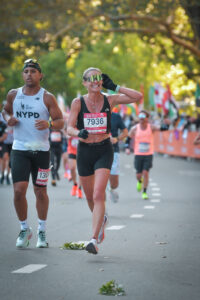
Getting into the NYCM is hard – general lottery, 9+1 (local runners), charity, or time qualifier. I had a marathon time qualifier, and decided on a whim to apply with that time in 2024. I figured I could use it as a fun run, and I’d be able to track and cheer most of my athletes after crossing my own finish line. With entry confirmed, my 2024 plan was to race the Berlin Marathon and then fun run the NYCM. But thanks to multiple bouts of covid and then an additional respiratory illness, my health and training spiraled. I decided to defer both for 2025.

Life happened again in 2025 in a few ways. One, I have a super senior cat. He’s 20 years old and truly my best buddy. He continues to have mostly good days, but has had some tough weeks. I just couldn’t commit to flying 8 hours and being on a 6-hour time zone change. I couldn’t live with myself if something happened and I wasn’t able to get back quickly. So I deferred Berlin (again) to 2026 and instead pivoted to a state-side goal marathon. I was accepted into the elite field for the St. George Marathon and while it would still mean traveling from my kitty kiddo, logistics would be much easier. My new coach (we began in April together) and I were on a roll, and I was building some incredible momentum by early Summer. Enter my right hamstring. Suddenly I was sidelined with tendonitis. My left hamstring has been a chronic problem over the years, and now that it was happy apparently my right one needed some attention.

Long story short, I had to pause all running for a few weeks. I worked hard in the gym doing leg day and PT work, and lived on an elliptical whenever I could. By early September, I ran 10 miles within a week. Peanuts compared to where I should be. I canceled St. George, as there was no way I could go from barely running to a marathon within 4 weeks – especially one with so many hills. And I honestly didn’t know if NYCM would be a good idea. I took things one day at a time, and was slowly able to get back to running 6 days per week. I got in two long runs, a 15 and an 18 miler. I got up to two 50-mile weeks. I was confident I could complete the NYCM if the hamstring continued to feel good. I was in it for a fun time and not a fast time, and took that decision to heart. It felt like such a milestone to pick up my first NYCM bib in 10 years. It felt surreal given the previous months that this was possible. And NYCM was my return to the marathon since 2023.

As a theater kid who fell in love with NYC at 26 years old, it was always the place I saw myself. The energy, history, and diversity of it all. The possibilities and potential. NYC is tough. She’s gritty and unapologetic. She can lift you up or trample you. She doesn’t care who you are, what language you speak or how long you’ve been here. We are all insignificant yet necessary cogs in the wheel. Moving to NYC in 2009, it truly felt like I was where I belonged. When I fell out of love with a career in the arts and into a career in run coaching, NYC is where the career change happened. As a person and a runner, NYC has shaped me more than any other place. I owe so much of who I am and how I coach to this beautiful and chaotic place.

Walking through Times Square at 4:45am to the bus to the starting line, tears filled my eyes. I usually avoid Times Square like the plague – most locals do. But with it being lit up and alive with yet nobody there but a handful of people, this is the New York I love most. Those quiet moments that feel like a secret when everyone else is asleep. I told myself to truly feel NYC that day – every encounter, every mile and every high and low. To be present and lead with joy. To take in the course as though I may never run it again – this way I won’t have any regrets if that’s true.

I smiled for probably 24 of the 26 miles of the marathon. I played with the crowd, yelled words of encouragement to other runners, truly had the most fun. I also ran perhaps one of my most evenly paced marathons of my career. my hamstring held up, and this felt like a true victory lap after a few years of setbacks.

Here are three things I did this marathon that truly set me up for success:

  • I took my three-day carb load seriously, consuming 450-500 grams per day.
  • I ran with a handheld bottle for most of the race. I started with 1000mg of electrolytes in it, and then paused to refill three times at aid stations. The sun was warm, so holding onto my bottle was very helpful.
  • I manually lapped my watch every 5K. This allowed me to stay honest with pacing (especially early!) while also not looking at my watch much at all. This allowed me to take in all of the neighborhoods and crowds.

It felt amazing to be a part of the day as a runner and not just a coach. But don’t get me wrong, my mind went multiple times to my athletes, and wondering what kind of days they were having. With my phone in my back pocket and notifications off, I did my best to balance my own day while also eagerly waiting for the finish line so that I could pull up everyone’s data on the tracker.

I know it sounds cliche, but each marathon teaches us something new if we let it. My biggest takeaways from Sunday: this sport is such a gift. We get to do this. PRs are fun, and while I am itching to race fast times again, PRs aren’t everything. Joy, being connected with others and ourselves, truly soaking in memories, feeling and seeing the best in humanity – those are sometimes the real wins.

I love New York.

 

Post-Marathon Advice

corky_fitness-2642finalwsharpeningflatwebSo you just ran your goal race for the season, and are riding a high and eagerly filling your calendar for next year. First, congrats! It’s an exciting feeling to finish your goal race – especially a marathon. It’s also common to set new goals, get excited for the future, and get back out on the road to get back to work!
Relax. Rest. Recover. Most marathoners jump back into running or running hard way too soon after their goal marathon. I understand the excitement. And many runners get nervous they will lose the fitness they spend literally months building. The idea of taking a few weeks off sounds unacceptable. There’s a fun half marathon in a week or two. There’s that Turkey Trot – I can’t possibly miss it!!!! Yes. You. Can. You need to remember a few things after crossing that finish line. The choices you make in the few days/weeks following that goal race can have huge implications on your future as a runner. I know, you may feel decent. But that doesn’t mean your body is actually recovered. In fact, injury risk is extremely high after a goal marathon, and immune systems usually drop briefly. This is your prime opportunity to get sick. Or injured. And you may not feel injured until a few months from now.

It’s a blessing but also a curse to have so many races hosted every weekend. The feeling of missing out, skipping an opportunity, not running with friends – I get it. But it usually isn’t worth going and putting your body through stress when it isn’t ready. The consequences could mean being forced to stop running for a few months or even a few years. And don’t underestimate mental burnout. Your brain needs some time to rest, reset and be on board to train for your new and exciting goals.

Maybe now you are on board with the recovery for a few weeks, but not happy about it. Okay, here are a few tips and things you can do to enjoy this time while losing minimal fitness and staying active in the running community:

  • Volunteer or go cheer at upcoming races in your area.
  • Ease into some easy cross training a week or two after your marathon.
  • If you dealt with injuries during training, address them now. See a doctor or physical therapist. Address weakness, tightness, and habits. We all have them.
  • Revamp your nutrition and cut back a bit on all those carbs and focus on fruits, veggies, lean proteins – try new recipes and have some fun in the kitchen!
  • Maybe try yoga, pilates, and a weight training routine during your recovery.
  • Catch up on sleep, your social life and any projects that were on the back-burner while marathon training.
  • Throw a party to celebrate your achievement! You may inspire a few friends to run the next year.
  • When the dust settles, write about your race experience. What worked well, what was tough or a mistake, and be honest. Your running journey will adapt over time. Learn from each race.
  • When you ease back into running, do it with no pressure or expectations of time. leave the watch at home and go by effort and simply enjoy the miles.
  • Trust that your body will bounce back and loss in fitness will be minimal, while injury risk will be extremely low and your body and brain will be ready to dive back into working hard.

Congrats again on your recent achievements! Now recover. As I say to my athletes, the rest and recovery is just as important as the hard work. Now is the time to really embrace that process. I want you clocking happy, healthy, and strong miles for years to come.

Running Injuries, Goals and the Gym

Berlin Marathon. Low mileage, lot's of time in the gym. Pretty good PR - 3:03:30.

Berlin Marathon. Low mileage, lot’s of time in the gym. Pretty good PR – 3:03:30.

It’s that fun time of year when there are literally dozens of races every weekend – from small 5Ks and 10Ks to some very large half marathons and marathons. The running community is filled with taper nerves, stories of recent race experiences, and reflections and goals for the new year. It’s a pretty awesome time to be a running coach and to watch the weeks and months of careful planning and training begin to pay off with some really incredible race finishes, personal records, and lessons learned.

I find that the journey can vary quite a bit per person. We are all different, and we adapt to training, goals and work load differently. I couldn’t help but notice while I was out for an 8-miler today how many runners I passed with medical tape, braces or bands on their body. It made me a little sad, angry, ad motivated to blog about it. In the non-running community, most people still assume running is bad for our knees. In fact, I cannot count the amount of times an acquaintance or total stranger says something negative about running and joints when they hear I run and coach runners. In fact, quite the opposite is true.

This isn’t to say that repetitive wear and tear doesn’t have consequences – cyclists, swimmers, dancers, tennis players – each sport has it’s own chronic injuries due to the muscles, tendons, ligaments and joints used repetitively. However, when done the right way, we actually usually stay far healthier and active when we use our body instead of sitting on our butts. Can running mess up knees? Sure. That will vary per athlete, their genetics, history, form, training practices, and overall strength. I come from the philosophy where most injuries are preventable, and most runners you see taped up simply didn’t train well. Usually they took on too much too soon (mileage or stress), or are incredibly imbalanced and could benefit from some serious strength training, cross training, stretching – or all of the above. Most injuries are preventable. Some obviously are not, and require immediate medical attention, and the diagnosis and advice should not be ignored.

Here’s the funny thing – most injured runners will willingly admit how much they are in pain, or how much their potential has been compromised, but yet they won’t take the necessary time off to rehab and recover. As a coach, I cannot help someone who isn’t willing to take the help. That may be the toughest part of my job. Knowing what needs to happen, but having an athlete unable to accept the work load, recovery, etc – to get there.

And so after witnessing all of those taped up runners today, I thought about myself and my running. I haven’t been injured (thankfully!) since 2012. I was forced to take 8 weeks off from running back then, and it was the worst two months ever. I swore to myself I would do what I could to avoid the injured list in the future. And so I finally began to take my own coaching advice. I also began to really listen and learn from my body. Dare I say, I began to train smart. Even when clocking 100-mile weeks while Ultra Marathon training in 2014, I quickly learned I needed to eliminate all speed work and simply focus on mileage. And when I shifted back to shorter and speedier goals, I cut mileage way down, and spent just as much time weight training as I did running.

In fact, that’s what struck me today. While training in 2016, my mileage was lower than most years in the past, ranging from 35-60 miles per week – including when marathon training. I’d cap my runs to 5X per week – no more, and 2 total rest days. I also spent a ton of time lifting heavy in the gym – upper and lower body – 2-3X per week for each. And for me, that combination lead to two of my three fastest marathons ever, within a 6-month span, and minimal aches and pains and no injuries.

And not only did the above combination work for me, I made myself be incredibly smart and conservative when hopping into any other races. Did I miss out on some incredible race opportunities this year in NYC? Absolutely. Did I have regrets or FOMO? Sure. And peer pressure is a bitch. But somehow I stuck to my guns, and my goals were clear. And so I didn’t add anything potentially harmful to the big goals.

Not every runner can spend hours in a gym. Or many simply don’t want to or refuse to prioritize their time. I get it. If you are very busy and love to run, you want to spend your free hour running – not in the weight room or on an elliptical. You want to be outside in the open air. I can totally relate. However, if you start to think about the longevity of your running career, and the specificity of your goals, you may start to view your training and choices a little differently.

So when you hit your off season, whenever that might be, I encourage you to take a hard look at your running and training history, and how your body has responded. Are you healthy? What hurts and why? Were your time goals achieved? How do you mentally feel? Listen, learn, and adapt.

Pacing in the NYC Marathon

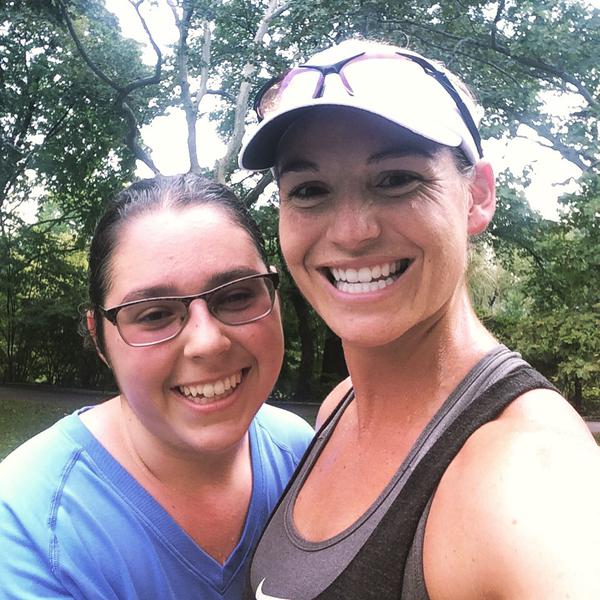
On a very humid training run with Shira in July as she prepared for NYC Marathon.

On a very humid training run with Shira in July as she prepared for NYC Marathon.

One of the greatest joys of my job is watching my athletes succeed. I get to watch them from the first day of training all the way through to their goals, witnessing the transformation that the months of hard work, dedication, and drive always deliver. On Sunday, November 2nd, between private clients, the City Harvest Charity Team, and runners who have been sweating it out at Mile High Run Club, I had over 100 runners stepping up to the starting line of the NYC Marathon. Many times, my work is done come race morning. I am left to frantically track my runners via numerous laptops and phones, or on the course cheering as my runners pass by. This year my work was a little different – I had the responsibility of pacing one of my private clients for her 26.2 mile journey.

As one might imagine, pacing a runner to their goals is a huge responsibility. It is also an honor. And it’s a completely different game to pace a pace group – simply locking in and holding a pace. When with one runner, you are with them through good and bad, needing to make modifications, judgement calls, and offer a ton of emotional support. Sometimes you need to talk them through the wall, force them to a medical tent, give them a shoulder to literally lean on, take walking breaks, try to make them laugh and think of happy thoughts, share their tears of pain and frustration. It’s always a journey of highs and lows, and you hope the highs outweigh the lows.

On Sunday, I had the job of pacing a first-time marathoner. She is only be 20 years old. I don’t know about you, but I know very few 20-year olds who run marathons. She also earned her way into the marathon via NYRR’s 9+1. She also happens to have a cognitive disability. She is incredible, and trained incredibly hard to get to Sunday’s starting line.

When I arrived at her door, I was greeted with the biggest hug and lots of excitement. Imagine a child on Christmas morning or at Disney World, and that’s perhaps close to the enthusiasm Shira had for race morning. I wish every runner was as excited to run 26.2 miles as this young lady!

Unfortunately, the day faced us with some really tough challenges: a delay on the Staten Island Ferry, a HUGE delay with the shuttle from the ferry to Athlete’s Village – so much so that we barely had time to get to our corral before it closed. Because of the delays, we both missed our opportunities to grab bagels, or even find the special tent we had been granted access to. Our very long and delayed trip to the starting line was overwhelming, and that caused the wheels to come off during the race. However, some fantastic support out there from Shira’s parents, relatives, teachers and friends were exactly what we needed to continue moving forward. At times we ran. At times we walked. We stopped for bananas twice, because Shira was starving. We stopped at a medical tent so that a medic could massage Shira’s tight quad. We stopped when we saw her family, so that she could facetime with her sister who was in Israel on Sunday. Through highs and lows, the miles ticked by.

What struck me the most was the support of the other runners out there. They were so supportive of her, often cheering her on, echoing my encouraging words, and giving her high-fives. While the crowded course for the first few miles was very overwhelming (I do not recommend someone with special needs to be in the last wave – it was too much for her), the runners around us were sometimes what got her through to the next mile.

Despite the difficulties, the minute we crossed the finish line after 5 hours and 38 minutes of being on our feet, Shira was elated. She was so proud of herself – and rightly so! Her strength is an inspiration to me and everyone who knows her.

Here are a few of my observations from the 2015 NYC Marathon:

  • In wave 4 (cannot speak for the other waves), many runners stop with their phones and selfie sticks for photos along the course – especially within the first mile as we go up and over the bridge. This was not only extremely frustrating, but also dangerous. In my humble opinion, cell phones have negatively impacted the race experience. Make memories and let the race photographers handle the photos.
  • Runners with special needs should not take the ferry – our morning included: a subway, a shuttle (subway had construction), a ferry, a shuttle, a walk. That’s a LOT of logistics/stress to handle. That wasn’t fair for Shira.
  • The race starts with cannons. If you were at the finish line of the Boston Marathon in 2013 and happened to forget that NYC marathon begins with cannons, you might jump out of your skin. You can guess how hard it was for me to keep my cool when that happened. I almost threw up.
  • There were hardly any porta-potty lines in our corral. That was pretty amazing.
  • Bagels/refreshments were nowhere near our village/corral. This was pretty awful.
  • The volunteers along the course were supportive and energetic.
  • At the finish line, we had a wrist band and permission to exit where the elite runners and Achilles athletes exit at west 72nd street. The NYRR staff would not allow us to exit, which was unfortunate considering all the extra work we had put into making Shira’s day as comfortable as possible – which had included months of correspondence with the folks at NYRR.
  • New Yorker’s are the nicest, most considerate people on marathon day. Suddenly everyone is supportive, smiling, and ready to help a runner any way possible. I wish that humanity would carry through the rest of the year.

Kathrine Switzer once was quoted saying “If you ever lose sight in human nature, go out and watch a marathon.” I agree. You see people at their most raw. You see blood, sweat and tears, and the will to push forward. You see human beings at their best and their worst – sometimes all at the same moment. If you ever feel dull and have the desire to feel “alive,” train and run a marathon.

After I left Shira’s apartment and headed towards an after party with my charity team, I was slowly able to start the process of checking results for all my other runners. My phone was flooded with emails, texts, missed calls, instagram photos, twitter updates – all from my athletes. It was amazing. The marathon is bigger than any one person, and perhaps that’s part of what makes it so epic.

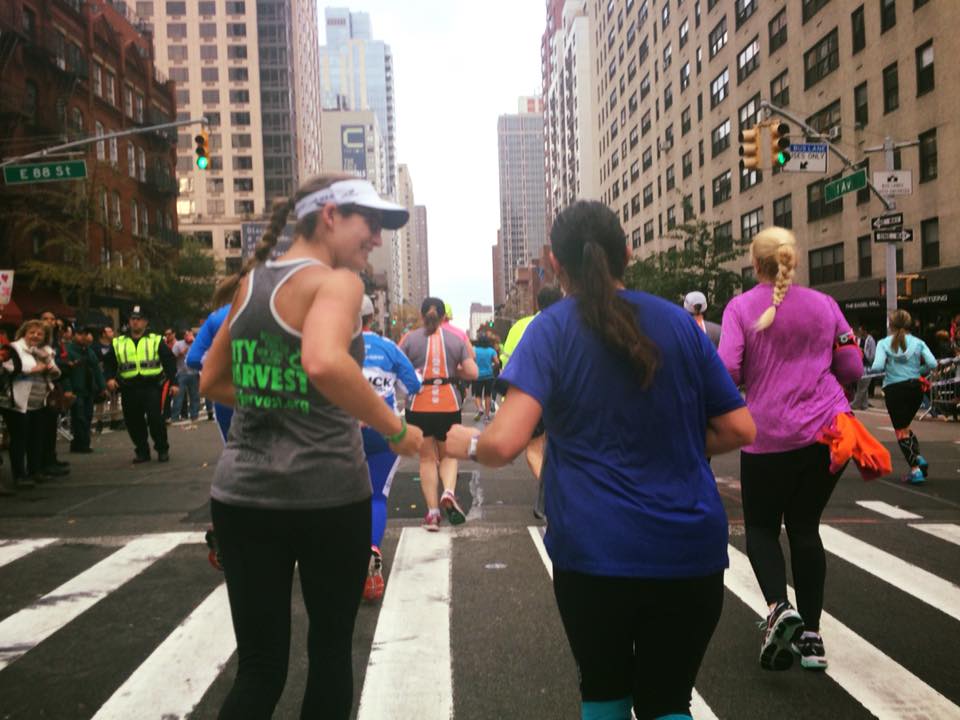
Mile 18 of the 2015 NYC Marathon, pacing Shira.

Mile 18 of the 2015 NYC Marathon, pacing Shira.