Race Report: Saints and Sinners Half Marathon

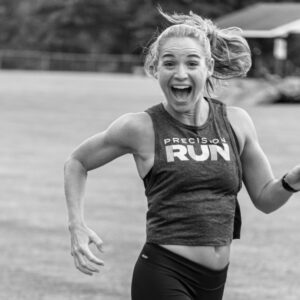
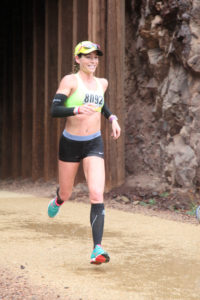
Flying down the final 5K or so. You can see how low the finish line was!

It’s been a hot second since I’ve released a new blog. It’s not that I haven’t been writing, but most of my writing lately has been for other platforms – Daily Burn, Under Armour, Runner’s World, Shape, and a few others. I’ve also been very busy preparing my private roster for their Spring race goals, and working my butt off training for my own race goals too!

Before I share my recent race experiences, I want to brag about my runners. So much hard work, and some incredible PRs outdoors in Winter conditions, at races around the country, and indoors and on the track. I am blown away month after month by the passion for running, the focus and the big goals my runners set and work towards with so much dedication. My runners inspire me to be better and try harder for my own running goals.

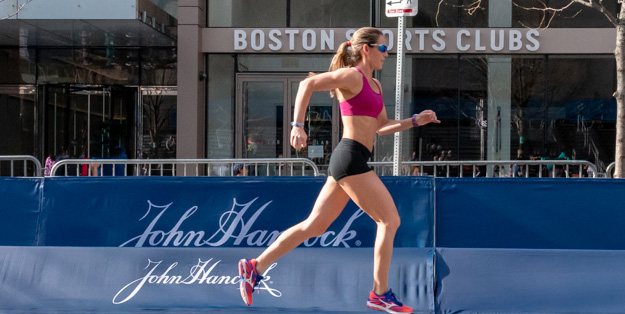
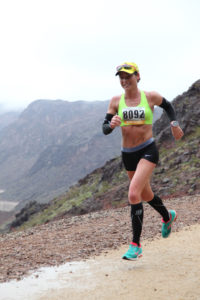
I do my best to lead by example as a coach, and have been working hard towards my ambitious Spring goals. While the Boston Marathon (April 17th), is my focus for Spring, I had set a half marathon race on the calendar to assess fitness, practice racing, and to set a new Half PR. I decided to look for a fast race – good weather and mostly downhill. With Boston as the goal marathon, I have been preparing for months for cruising up and down hills, and so a net downhill course sounded like a sure thing for a PR and a great opportunity to test out my legs. After some digging around a research, I settled on the Saints and Sinners Half Marathon, in Las Vegas. The course seemed beautiful and incredibly fast – with a point-to-point, 1200+ foot decent. The course is also a combination of paved bike path and incredibly soft and manicured gravel trails, taking you through the desert, numerous tunnels, and finishing at the base of Lake Mead. I was confident that between my training and the downhills, I had a 2-3 minute PR in me. I haven’t had awesome conditions for the last couple of half marathons I have attempted to race (including my previous PR), so I knew that the odds were really good I could drop my time a bit. And honestly, I knew going into it that I was perhaps at my fittest, fastest and healthiest for this kind of goal than ever.

Despite a few hiccups in Las Vegas, including a broken ankle on our shake out run on the Strip and 3+ hours in urgent care with Chris, and chilly and rainy conditions in the forecast for the entire weekend, I tried to stay calm. In years past, this would have thrown my confidence and quite possibly my race. But I now have become pretty decent at focusing on the task at hand with running, and knew once I got to the starting line I’d be okay. Even when Google maps made an update and sent all the runners to the wrong point for the starting line, I tried to not lose my cool. We parked literally 30 minutes before the gun went off, which in the past would have made me a wreck. While I didn’t love feeling rushed in the rain, I didn’t let it ruin my morning.

At the starting line I took a breath, relaxed and let go of everything around me but the race. The first 3 miles were incredibly fast. I was hitting 6:00 minute miles, which is typically around my 5K race pace. However, it was simply the drop in elevation and the course was doing the work, and so I tried not to freak out by the hot pace. About 10 runners were ahead of me for the first 5 miles, including one female for the first 3 miles. I then passed her and never saw her again. Between miles 4-7 there are some gradual declines and flat portions, so I was able to settle into a pace that seemed more acceptable: 6:15-6:25s. I ran miles 4-8 with a runner from Arizona, and we chatted here and there. He mentioned he had just recovered from brain cancer, and was looking to finish in under 1:30. I told him that his goal seemed incredibly attainable, as we were on our way to the half way mark way ahead of that pace. (Turns out he crushed his goal and finished in 1:22!!!!)
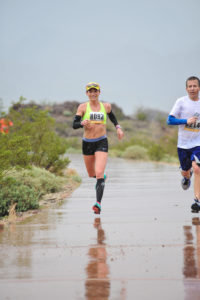
It was raining pretty hard around mile 5. Sharing miles with Josh, from AZ.

Coming through the 10K mark and an aid station, he and I were #8th and #9th. At mile 7 there was our only climb worth mentioning, and I said that now, on this climb and during the second half is where the work happens. I felt strong on the uphill, and the views of the lake, even in the rain, were beautiful. We passed a few men on the course, and began going through the tunnels. Around 8-9 miles in, I slowly pulled away from Josh and began gaining on a few other men. Each one was incredibly nice, and I tossed positive tips and comments their way.

The aid stations and volunteers at the turnaround (a small part of the course was an out-and-back) were the highlight of the race for me. It was at the end of a big tunnel, and the kids at the aid station were so excited to see the first female come through. I couldn’t help but feel like a role model for the young girls watching and volunteering. On the “back” portion, Josh and the few men I recently passed gave thumbs up, words of encouragements and cheers. Glancing at my watch around mile 9-10, I knew a big PR was in my hands if I didn’t do something stupid like roll and ankle, and continued to feel as smooth and strong – it was a little surprising and I kept waiting for the blazing early miles to catch up and compromise my pace or effort – but that never happened. I now knew the win was mine, as the next female was a good 5-8 minutes behind me at this point.

I had to stop at the mile 10 mark to tie my shoe. I couldn’t believe that with a double-knot and tucking the laces under themselves that my right shoe was untying! At first I thought maybe it just felt heavy and loose because of the rain and puddles, but a quick glance down and I could see loose laces! So I stopped, took a deep breath, focused on having my somewhat chilled fingers work, and then get back to running. The final 5K was incredibly fast (thanks, elevation drop!), and I was able to drop pace to 6:05-6:15 minute miles. With 2 miles to go, I was doing the math in my head and it all felt unreal. The thrilling part was that I felt awesome. Really awesome. Form felt smooth, breath felt controlled, and I simply worked with the race course.

Coming through the finish line in 1:21:13 was surreal. I never in my wildest dreams thought I’d ever see that number for a Half Marathon. It’s funny how we all tend to define ourselves and our potentials. It isn’t until we prove our limitations wrong that we see ourselves in a new light. Unlike Berlin Marathon, where I struggled so much for that PR and to keep my body and brain on board, this race felt easy and in control from start to finish. The only bummer: no finish line tape. I find it sad that women don’t get their moment of glory the way men do. I finished 5th overall, and 1st women by 10 minutes. And while there was no real prize other than a water bottle, the PR and strong race experience was all the winnings I wanted.
Now, here’s the thing: there’s absolutely no way I could run a 1:21 Half Marathon on a course with less hills. No two courses are created equal. This course handed me that time. I’m not saying I didn’t work for it, but that time would not translate the same to say NYC Half Marathon. My guess is that same performance would give me more of a 1:24-1:25. But that’s why it’s important to choose your races wisely. What’s your objective? What is your ace? Your weakness? I don’t need crowds and tons of people on the course to run well. Others do. I know how to run hills perhaps better than flat courses. Others don’t. You are different from the next runner. Learn what works for you.

And so this past week as I focused on easy miles (my legs were pretty trashed from the course!), I tried to let my big breakthrough of a 6+ minute PR settle in. I’d like to go back and race this course and/or the Poconos Half in 2018 and aim for 1:19. Both are incredibly fast. And I think I can do better. I am also transitioning all focus towards Boston. I know what I have to do to get the job done. And while aiming to break 3 hours won’t be easy, I am more confident now than ever that there’s the potential for it that this April.
The Twelve Myths of Fitness – Day 5: No pain, no gain

It’s been ingrained in gym culture, sports, and perhaps our common conception of exercise: it’s supposed to hurt. Perhaps this is why so many people hate to exercise or run. While yes, there is definitely discomfort that can come and should come with training, that is very different from injury pain. The lines between the two seem to often blur, and that’s not a good thing. So today let’s clarify what sensations should be associated with exercise and which ones should not – and how to recognize the difference and make good decisions when those pains arise.

When ramping up training, or jumping into something new, it’s important to build the work load carefully and consistently. Not doing so will increase both injury risk and general discomfort. For runners, for example, this is why building base mileage is necessary before tackling intense runs. Or why going from absolutely no exercise to 3-hour gym sessions will practically destroy many of us. And rightly so. You are shocking your body!

Discomfort can come in a few different forms – pain while in the act of training – running hard on a track isn’t comfortable, or pushing out that final rep of chest presses – but that’s not injury pain. That’s the discomfort our body will adapt and grow from. The heavy leg feeling towards the end of a long run can be incredibly uncomfortable, especially when pushing the time on your feet. But again, this is the kind of stress our bodies need to experience to learn to run longer. A day or two after training, it can be normal to feel soreness, tightness, or weakness. While there are things we can do to help alleviate that discomfort (hydration, rest, compression gear, stretching, foam rolling, light exercise, ice baths), that discomfort is simply part of athletic gains. This discomfort isn’t an injury. It’s simply your body going through the process of learning and adapting. The good news is that the more of a habit your training becomes, and the stronger and more adaptable your body and brain, the harder you’ll need to work to feel discomfort. This isn’t to say that you’ll feel amazing and agile at mile 23 of the marathon, but it will mean mile 14 won’t hurt the way it maybe did 4 months ago.

Injury pain is very different from discomfort. While there’s a stigma that badass athletes train, race and compete through injury, that’s a really bad way of handling yourself, your attitude about your body, and your goals. There are always exceptions to the rules. For example, many NHL players are expected to play through broken bones during the playoffs. And I’ve known many a runner opt to still run a marathon with tendonitis. Are those decisions smart? No. Worth it for that person or team in the situation? That’s a personal decision. But we need to be careful and remember than training through an injury doesn’t make us a dedicated, badass warrior. It makes us idiots, with usually big consequences down the road.

Sometimes it’s hard to tell the difference between discomfort and injury. Remember that unless you are actually a doctor, looking things up online or talking to your lifting or running buddies is not the smart course of action. See a medical professional. A diagnosis, especially early on, can make a game-changer. Some injuries like runners knee, ITB, shin splints – can be managed and not totally derail training or racing, But a torn rotator cuff, tendonitis, a muscle tear – these are things we should rarely train through. It’s important to know what you’re dealing with so that you can make smart choices. If you can’t see a doctor right away, take a few additional rest days and see if that helps. If it does, carefully ease back into your activity and see how it feels. If it doesn’t help, you definitely need a medical opinion before training again.

An overwhelming number of runners say they battle injuries as part of their sport. I find that sad, and a statistic that doesn’t need to be so high. Smarter training, self awareness, and remembering that each and every runner is different and you need to learn and listen to your body, can help you not be part of such an overwhelming statistic. Look, I get it. I have said yes to races, runs with friends or team mates, and pacing opportunities with my clients when for my own body and training, it wasn’t a smart idea. Sometimes the risks don’t have huge consequences and we get lucky. But other times we pay the price.

Just remember that pain is a signal our bodies give our brain that something is stressed or hurting. Signals should never be ignored. We only have one body. Do your best to keep it healthy and happy.

The Twelve Myths of Fitness – Day 2: Running is bad for your knees

If you are a runner, you’ve probably been asked this a thousand times: Isn’t running bad for your knees?

And if you’re not a runner, perhaps that’s your belief or assumption. In general, the answer is no, running is not bad for your knees. That’s an old wives tale. In fact, I’d argue that it’s in fact good for your knees. However, we are all different. And so is running good for your knees? That depends. Here’s a NY Times article discussing why runners don’t tend to get arthritis in their knees.

Any highly repetitive activity can have consequences. Overuse is a common issue for many athletes – be it a basketball player jumping, a tennis player and their elbows, or a dancer and their hips. Doing something repetitive day after day, year after year can cause problems. However, when supplemented with other activities, done wisely, and with good genetics, running can keep humans active, agile, strong, and enjoying a sport they love way into their golden years. While I’d argue running isn’t bad for many of us, I’d also argue that many runners don’t supplement their running wisely or train in a smart manner.

Statistically, many runners overtrain or train with little purpose or guidance. Many runners also don’t respect their body’s need to recover and rest – be it rest days during the week, or taking some significant time off after completing a big goal race, like a marathon. In fact, I’d argue most runners are pretty stupid when it comes to their training choices. I’d be the first to admit I’ve made those mistakes and learned the hard way. Sometimes runners simply don’t know any better, or they have FOMO and cannot force themselves to take time off. I’d also argue that most runners don’t strength train or cross train enough. So a flawed training schedule or plan can lead to angry knees, hips, shins, feet, tendons – the list goes on. So if a non-runner asks the average runner about their injuries or knees, they may hear their opinion on knees and running validated.

It’s important to understand that body weight, shoes, form, and running surfaces can also be factors in how happy your joints are with your weekly miles. I’ve found many of my runners with a history in martial arts and track and field events like long jump tend to have issues with running and keeping their knees happy.

If you still aren’t buying the whole “running is good for my knees” concept, here are five expert opinions. For many of us, the benefits far outweigh the possible damage or consequences of running. Just remember that you only have one body, and you should run, train and race with the big picture in mind – active decades to come – not just your races on the calendar this year.

Race Recap: Berlin Marathon


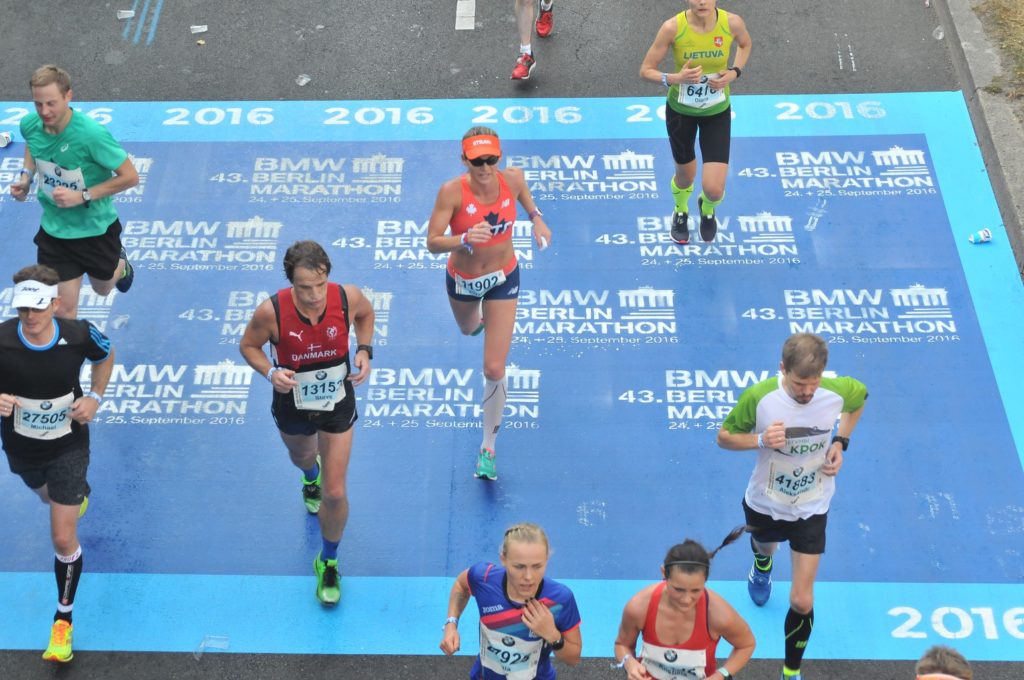
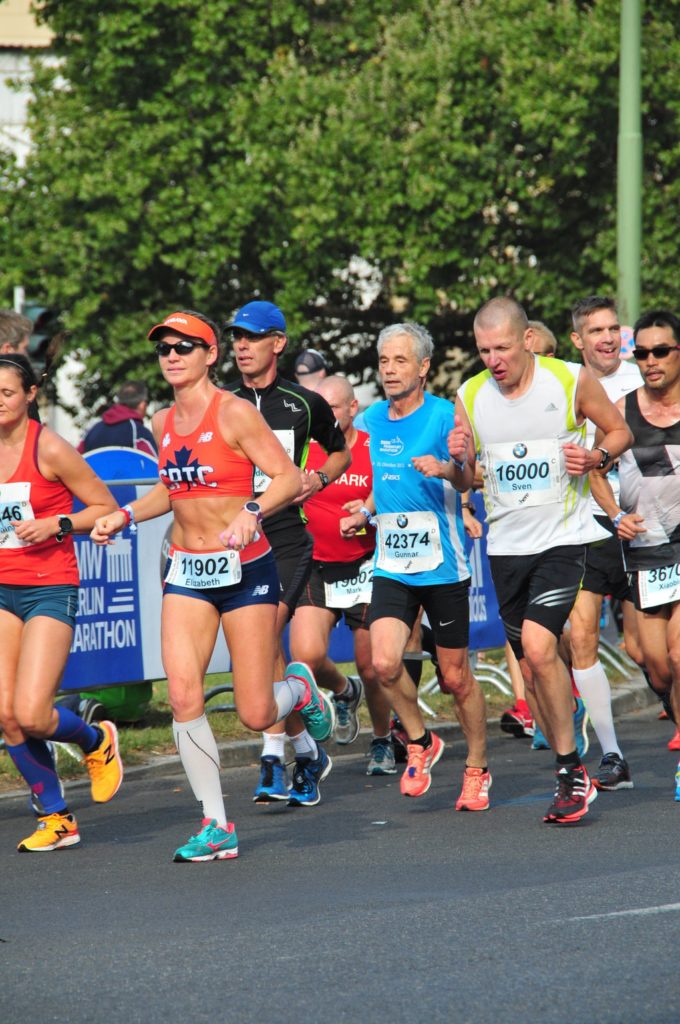
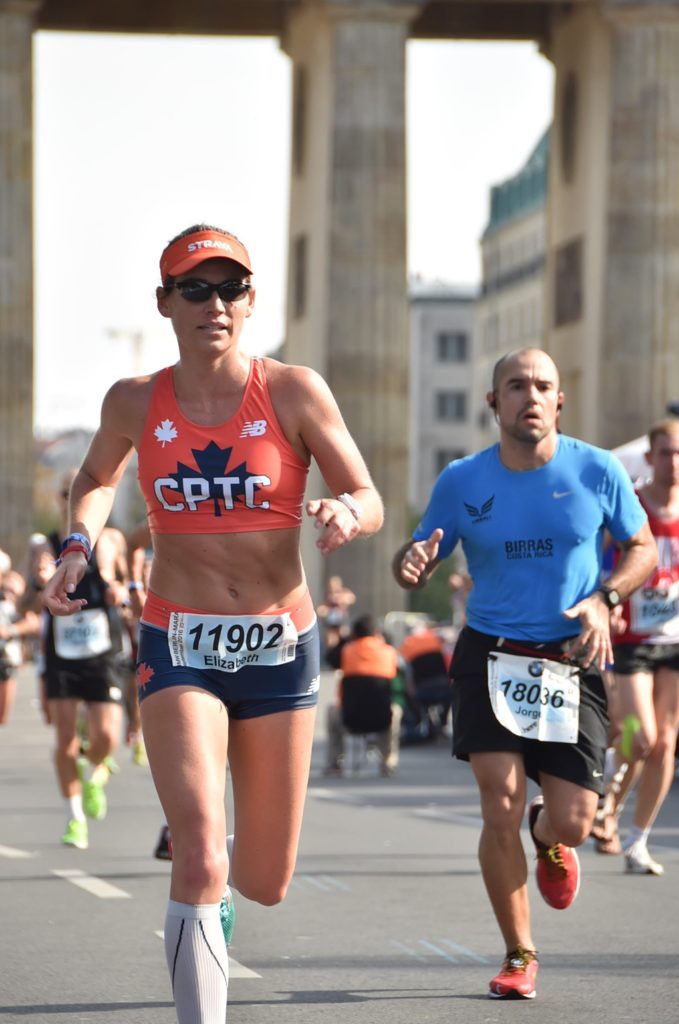
Early in the race. Feeling relaxed.

Early in the race. Feeling relaxed.

Berlin Marathon had been on my radar since I was notified I’d been selected via lottery back in December 2015. With a reputation for being the fastest marathon in the world, I knew if I went to Berlin, I’d go to race – not to simply run. This would mean training to race my first marathon since 2013. So over 10 months ago the goal was set: race Berlin 2016, aim to break 3 hours, or set a new PR.

The road to Berlin wasn’t easy. Some days or weeks would click into place. Others were a struggle, and filled with doubt. I questioned my decision to coach myself on more than one occasion. There’s a reason why many coaches hire someone else to coach them – it’s hard to be the student and the teacher. I questioned my potential. Was my 3:05:27 back in Philly 2013 as good as it gets? But doubts never lead to anything good. And I knew my training was smart. So I’d try to shake those doubts and focus on the good and great workouts. Just like bad weeks of training come and go, so do good ones. Neither one defines us. I am thankful to be surrounded by some incredibly supportive people. Friends, coworkers, team mates, family – people who understand or at least respect the grind. My roster of private athletes have cheered me on. And so when the going would get tough, I’d remember to lead by example and continue to grind away. By the time I got to Germany, I knew all I could do was trust my hard work and preparation, and have confidence in that.

I had never been to Berlin before. It’s a really beautiful city. I was oddly calm about marathon morning (I’m usually a basket case), and was actually capable of enjoying the city for a solid 36 hours before race day. The day before the race was spent walking at least 4 miles around the city, and a 3-mile shakeout run that evening. I ate pasta with a German beer, laid out my running gear, and that was it. Was I nervous? Sure. But I was also calm. I accepted that it was going to be 3 hours of work, and that I was ready.

The weather race morning was perfect. Cool and sunny, with no breeze. The marathon gods were good to us. As I stood in my corral, and the announcers counted down to the started, I began to cry. I was overcome with the power of the moment. The amazing park. The
40,000+ other athletes. The opportunity before me. I quickly collected myself, and within a few minutes I was across the starting line.

The course is fast. And there’s a blue tangent line on the course. I decided I’d stick to that line as though it were glue. This was the first marathon I’d ever run with no mile markers (only kilometers), and I was one of few athletes around me who’s watch would go off at the miles. I told myself to stay relaxed and efficient. I hydrated early and often. Around the 20K I saw Vinnie, and that was like a kick of energy. In an unfamiliar city, a familiar face was priceless. Around 17 miles into the race, I felt amazing. Pacing was good. I felt that a sub-3 was going to require a kickass final 10K, but a PR was mine to lose.

535044_237057350_xlarge

Eye is on that clock.

Then around 19-21 miles in, a few things happened. One, I began to cramp. Not runner cramps, but lady cramps. The kick in the uterus feeling, on my right side. In the beginning it was relatively dull, but as the miles went on that changed. I was incredibly mad at myself, as I had planned to take ibuprofen that morning (I’d had cramps off and on for a few days), but that morning had felt good and I opted to go it without precautionary meds. And then the nausea and gag reflex to GU began to happen. It was a burp that turned into a “Oh no, I just kinda threw up in my mouth” moment, and this was before I needed to take my final GU around 20 miles. I forced that final GU down, but it wanted to come back up. The final 5 miles were a painful negotiation. I debated stopping for a break and to try and regroup. I debated walking off if Vinnie were at the next turn. My body was struggling and my brain wasn’t giving me the ability to simply pick up the pace.

I told myself to do what I could. If I lost my PR, it wasn’t the end of the world. Just do your best. Just finish this. And so I continued. Paces slipped. I walked through a hydration station in the 23rd mile, hoping that brief pause in running would help the cramps. It made it worse. And so back to running I went. My eye on the clock, I took it one mile at a time. I saw Vinnie around 24 miles, and I mumbled something about this really hurting as I pointed to my side. He ran beside me for half a block, yelling encouraging things, to which I told him to shut up and stop lying. And so I continued.

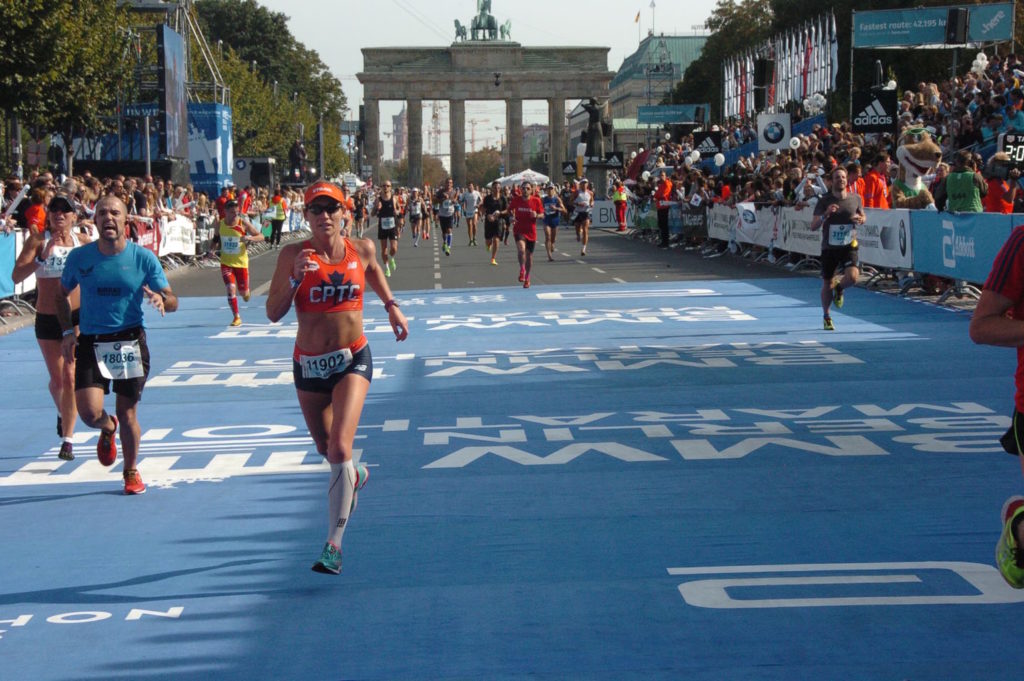
The final 600M of the Berlin Marathon is spectacular. I think. I don’t really remember. The final stretch was lined with people. I focused on the clock. You can see the finish line a long ways before you get there. Glancing at my watch, I knew a PR was in the cards, but by how much – I wasn’t sure. Just finish this. Just get there. Just get this done. That’s all I could think about. Crossing the finish line I felt relieved, tired, emotional, and still in pain. The nausea was thankfully replaced with hunger by the time I got back to the hotel. And I took ibuprofen immediately to kick said cramps to the curb.

The rest of the day was filled with walking around, beer and food. I am in shock (and a little mad) at how good my legs felt after that marathon. There was so much more left in them to give. But they couldn’t have their day. My disappointment didn’t last long. How can it? I did the best I could that morning. And yes, I walked away with a PR. That PR, that much closer to 2:59:59 – it makes me that much more hungry for it and that much more confident it’s in me.

Here are the official stats:

535044_237095576_xlarge

Finish time: 3:03:30 (average pace: 6:58s)

100th female (11th American)

Splits:

Mile 1: 6:50, Mile 2: 6:51, Mile 3: 6:56, Mile 4 :6:58, Mile 5 : 6:51, Mile 6 :6:57, Mile 7: 6:49, Mile 8: 6:52, Mile 9: 6:53, Mile 10: 6:48, Mile 11: 6:51, Mile 12: 6:52, Mile 13: 6:49, Mile 14: 6:53, Mile 15: 6:54, Mile 16: 6:54, Mile 17: 6:57, Mile 18: 6:59, Mile 19: 6:55, Mile 20: 6:57, Mile 21: 7:07, Mile 22: 7:02, Mile 23: 7:13, Mile 24: 7:30, Mile 25: 7:12, Mile 26: 7:17, .34 miles: 2:13.

A few tips for future Berlin Marathoners:

  • Stay at Hotel Adlon Kempinski. It’s worth the money. Not only is the hotel gorgeous, quiet and comfortable, but it’s literally at the Brandenburg Gate – a very short walk to the start/finish lines and on the marathon course.
  • Make morning preparations the night before. It turned out the hotel had some food/coffee for marathoners in the lobby, but no coffee shops open before 8am (some 10am) on Sundays. I bought a bagel and coffee from Dunkin Donuts the night before.
  • The expo was a mess. So go to it patient, and ready to get in/get out. I couldn’t have really shopped for anything if I had wanted to.
  • Be sure to plan to use your own fuel. The drink and fuel choices (which included Red Bull) on the course were new to me. I stuck to water the the 4 GUs I brought.
  • When planning your trip, account for jet lag. It’s not every day I run a marathon at 3am. Do everything you can to get on schedule before race morning.
  • Go for your shakeout runs in the Tiergarten. That park is the most stunning thing ever. 535044_236930700_xlarge

Racing Weight, Body Image and the Scale

Summer 2007, going to guess 135-140lbs. I was running a little at the time, but also on diet pills, birth control, and stress eating at a theater gig.

Summer 2007, going to guess 135-140lbs. I was running a little at the time, but also on diet pills, birth control, and stress eating at a theater gig.

Clothing size and the number on the scale can often torment or define the happiness of many of us. I’ve been very open about my relationships with food, body image, and an obsession at times with my size and the number on the scale. In today’s blog I’d like to discuss that number on the scale in regards to running and athletic performance, but also to address the human struggle.

I’m asked all the time about body weight and speed. It makes sense that the lighter the runner, the faster and more efficient the athlete. This is true in a lot of ways. Runners chasing down a specific time goal often look for the lightest shoe they can handle. Every step, stride, arm swing – that takes energy. When every second counts, so does every ounce. HOWEVER, athletes need to be careful to not lose too much muscle. An athlete who is under fueled and lacking good strength will be prone to injury, poor form, and can feel their training plateau because they are not fueled for training or racing. So there needs to be a safe, realistic, and honest assessment of finding that sweet spot. Extra weight isn’t good, but neither is being under weight. For my athletes, I always promote eating to support their training needs. Usually extra weight tends to disappear, but the athlete is also successfully fueled to knock those hard runs out of the park. This isn’t to say that runners always lose weight. Some can gain weight, as their appetite increases and perhaps they get a little carried away. It’s a balance. And a process.

A post-race photo in 2011. Just ran a new Half Marathon PR. My lightest weight of my adult life - 119-122lbs.

A post-race photo in 2011. Just ran a new Half Marathon PR. My lightest weight of my adult life – 119-122lbs.

There have been times in my running career where I gained weight while training (and no, not muscle), and times where I have dropped a lot of weight. I’ve experienced the consequences of both. I’ve lost some speed when heavier. I’ve also been injury prone when lighter. It was a journey for a long time. But after my lowest weight, in 2011-2012 – about 119-123lbs., and suffering an injury, a few things changed for me. One, I started weight training in 2013. Not stupid 5lb. shit. Seriously lifting weights. This was also when I got my Personal Training and Nutrition certifications, and my view on the human body changed. But most importantly, this was when I STOPPED weighing myself every damn day. It had become an obsession. A game. Something I could control. I never starved myself to be super skinny, but I trained to lose weight, period. I trained stupid. Once I stopped training like an idiot and weighing myself, a few things changed. I gained muscle from head to toe. I had muscles in my upper body I’d never seen before. And you know what? That was fucking awesome.

Since 2013, I have been consistently (more or less – there are certainly weeks where I don’t make it to the gym!) lifting heavy. In early 2015, I added heavy lifting for my lower body. Not only have I become a much more efficient runner, my aches, pains and injuries have thankfully been almost non-existent. I hop on the scale every few months (maybe, if that?), and have been a consistent 131lbs. for the last 3 years. I’ve been proud to be 131lbs., 5’7″, and strong. I want to be an example that the number on the scale doesn’t define shit. Strength does.

June 2016, after a race. Probably weighing 128-130lbs.

June 2016, after a race. Probably weighing 128-130lbs.

One thing that has been consistent since 2011 – I track my calories and activity. Like a hawk. I measure and weigh most food I prepare. I read serving sizes. I’ve gotten really good at eyeballing food that I don’t prepare. I track it all. I also track all my activity. Not just the training, but sleep, standing and sitting. I know exactly what I’ve consumed/burned per day, the average per week, month and year. That knowledge means I am always accountable. Yes, it helped me to drop to an unhealthy weight/composition in 2011, but it also helped me gain weight back in the form of mostly muscle, and fuel my training needs appropriately. And yes, it means I have to hold myself accountable and enter in all that data, but for my training, goals and general health, it’s worth it.

Now, I found myself taking a hard look at my goals for 2016. My goal for Berlin Marathon (EIGHT weeks away!) is fucking ambitious. So I looked at my data. A hard look. The amount of miles I can safely run per week. The types of workouts. The best way to fit in strength training. And my current body. I stepped on the scale in May, and clocked in my consistent 131lbs. I looked in the mirror and was honest. Not “self loathing, wah I wanna be skinny” assessment, but a purely “how do I do everything I can to be my best” assessment. I decided if I could drop 5lbs. carefully between May and September, losing body fat and minimal muscle, I would be improving my odds for achieving my goal on race day. And so, I have been working for weeks to whittle that number down. This week the scale has read 126lbs. and 125.4lbs. on days where I was well hydrated and fed. Goal achieved! Now I need to maintain that number. There’s a part of me that is eager to take that control of the scale to the next level, and try to drop more. I’ll be carb loaded on marathon day, and that will mean gained weight. But there’s the sane and rational side of me that knows my body and that I need to stay injury-free, and fueled for my training.

My relationship with the scale is rarely healthy or happy for long. Which is why I rarely use it. I’d feel bad when that number went up, or happy and in control when it would hit a new low. Which is silly. And so I usually measure myself by my athletic abilities, and how clothes fit.

I joke and brag about my love for pizza, Chinese food, and Ben and Jerry’s ice cream. I do genuinely love them all. So very much. And I eat all three quite frequently. But I also fuel my body with lots of fresh fruit, veggies, dairy and lean proteins. Those calorically high loves are accounted for and tracked. And I train like a beast. My body doesn’t look or act like it does because I sit on my butt or train sporadically. There is a ton of sacrifice (sleep and a social life), and sweat, tears, frustration and grunt work that goes into what I look like and what I accomplish. I’m a work horse. Plain and simple. What I lack in talent, I make up for with effort. I also have learned to value rest days. Those are the days we are actually rebuilding and getting stronger!

That scale. That number or letter in every article of clothes. They do not define any of us. We often let them drive our motivation, confidence, and our self worth. Often those numbers sabotage us in achieving our goals. But those numbers can change. One way or another. Take that control. Take your body and recognize that you can do anything you want to with it. Anything. It’s pretty fucking incredible. You could train it for anything and everything. Sure, it takes time, sometimes failure, and always hard work – but it’s possible. Once we begin to see our bodies as anything other than the obstacle, the sky is the limit.