Run Coaching: Runna has entered the Chat (GPT)

Run Coaching has evolved in a big way in the last few years for a few reasons. First off, we have AI – so resources like ChatGPT and Runna are now tools we didn’t have a few years ago. There’s also been a huge surge in the amount of certified run coaches, thanks to many certifications going purely or mostly remote since the 2020 pandemic. Certification programs have recognized they can crank out coaches at a much lower cost to the organization and with more ease. A runner interested in becoming a certified run coach no longer needs to commit a whole weekend (and potentially travel logistics) to become certified.

As a coach who’s been in the industry full time since 2015, and as a runner who began running and training for races in 2010, I am going to do my best to share the pros and cons of an AI program and a running coach. I will do my best to reserve my biases, though I’ll freely admit I have one.

When I signed up for my first marathon in 2010, times were different. There weren’t a ton of online training plans, I didn’t know run coaches were a thing, and I relied heavily on the Runner’s World Magazine to drop in my physical mailbox each month. I found a printable marathon plan on the NYRR website, and used that as my road map.

I was also very much living on a budget. I was in the tv and film industry full time, and I never knew when my next paycheck was coming. So investing in a magazine subscription for nuggets of wisdom and then using the printed plan as my guide fit my budget. My schedule was also unpredictable. You never knew if you’d have a 4-hour day or a 16-hour day on a set, so suffice to say I trained when I could. My journey to my first marathon ultimately looked little like that printed plan by the time race day arrived. Thanks to some dumb luck and good instincts, I got to the starting line of the Philly Marathon in 2010 healthy and capable of accomplishing my goal of a Boston Qualifier.

In the next few cycles, I got my hands on books – Daniels’ Running Formula and Pete Pfitzinger’s Advanced Marathoning, and they became my new roadmaps. But as we’d probably expect, I had to make changes to the programs to balance work, illness, injuries, vacations and so on. The beauty of these books was that I had to make changes and then trust my adjustments. I was never blindly following a plan.

I view ChatGPT and Runna as being in the similar camp as a book. For one thing, nobody can argue the price point. These resources are inexpensive or free. But the big danger, and something I’ve seen over and over: is that runners are blindly following these plans and assume that any “adjustments” made by AI are correct. We’ve become so accustomed to technology being reliable and sometimes smarter than ourselves, that we ignore our own instincts.

Another huge change since the 2020 pandemic: not only are there more certified coaches, there are way more runners! The running boom post-2020 has evolved in a way that still boggles my mind. It’s incredible how many people have fallen in love with running, racing, and being a part of running communities like run clubs. But we don’t know what we don’t know, and many new runners can and do easily fall victim to following AI blindly. This isn’t to say that Runna or AI are bad or dangerous, but they can be – especially when a runner is new to the sport.

Let’s not forget that due to the repetitive and high impact nature of running, about 60% of all runners navigate an injury of some kind every year. It’s an unfortunate consequence of the sport, but I’d also argue one that we could collectively lower by running and training more wisely. For example, many of us (new and experienced runners alike) build mileage, frequency and/or pace too quickly. Many of us also get excited and want to dive into something like marathon training without an adequate foundation, or we try to stack seasons without respecting the stress and need for down-seasons between builds.

When we ask AI for a program, we get the result of what AI collects via algorithms combined with what we share with it. In theory, AI will tap into training principals that you’d find in a book like Daniels’ Running Formula, but this may or may not be how it goes. And you are trusting that AI somehow understands your injury history, work/life balance, stress levels, vacation plans, and so on. An experienced runner or someone with coaching certifications could use AI to create a plan that they then adjust as needed. Having the experience and skills to adjust could make an AI program quite fun. Runners without the experience or skill set should proceed with caution.

Here’s where I’ll put on my run coaching hat: successful training is so much more than a training plan. It’s support regarding race strategy, nutrition guidance, motivation and inspiration, and empowering that individual through the highs and lows of training and of life. It’s also support in how to change a training plan for injury, illness and vacation. It’s about going beyond the data and empowering an individual to chase their goals and better their relationship with running and themselves as people.

I’ve personally been self-coached off and on since 2010. My resources? A dozen run coach certifications and their course material, and countless books with plans and guidance from some of the best coaches in the world. I also have data and race performances on myself from the last 15 years. And I currently have a coach. The best athletes in the world do. Not because they don’t know what to do, but because guidance from the outside, or experiencing different philosophies and strategies can change the game.

I get it, hiring a run coach isn’t cheap and can sometimes feel like a selfish use of funds. Coaches range from $75-500/month, often due to their location, experience, and whether they view this as a full time job or a side hobby. Many of us can’t or won’t want to invest in a run coach. Though I’d argue as both a runner and a coach, that if you really care about your relationship with running or racing, it’s beyond worth the investment if you can swing it.
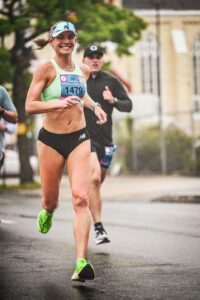
Like I mentioned at the beginning of this blog, there’s been a boom (and I’d argue over-saturation) in the run coach space in the last few years. The good news is that this means there are eager (though potentially green) coaches out there at a lower price point. Your choice doesn’t have to be “free AI” or “$350/month coach.” You could gain the guidance of a coach while that coach builds confidence in themselves and their new craft. And selfishly, I’d like to see run coaches continue to be relevant instead of replaced by a computer that can’t do the same thing.

AI isn’t going anywhere. It can absolutely be a great point of entry for runners, as long as they don’t blindly follow it. We just need to recognize that no training plan, be it via Runna, Pfitzinger’s Advanced Marathoning or a program your personal run coach creates for you will be perfect as-is. There WILL need to be adjustments. Whether a coach is making those adjustments for you, or you are doing them on your own, remembering that the goal is to stay healthy and consistent so that your running can take you wherever you want it to go.
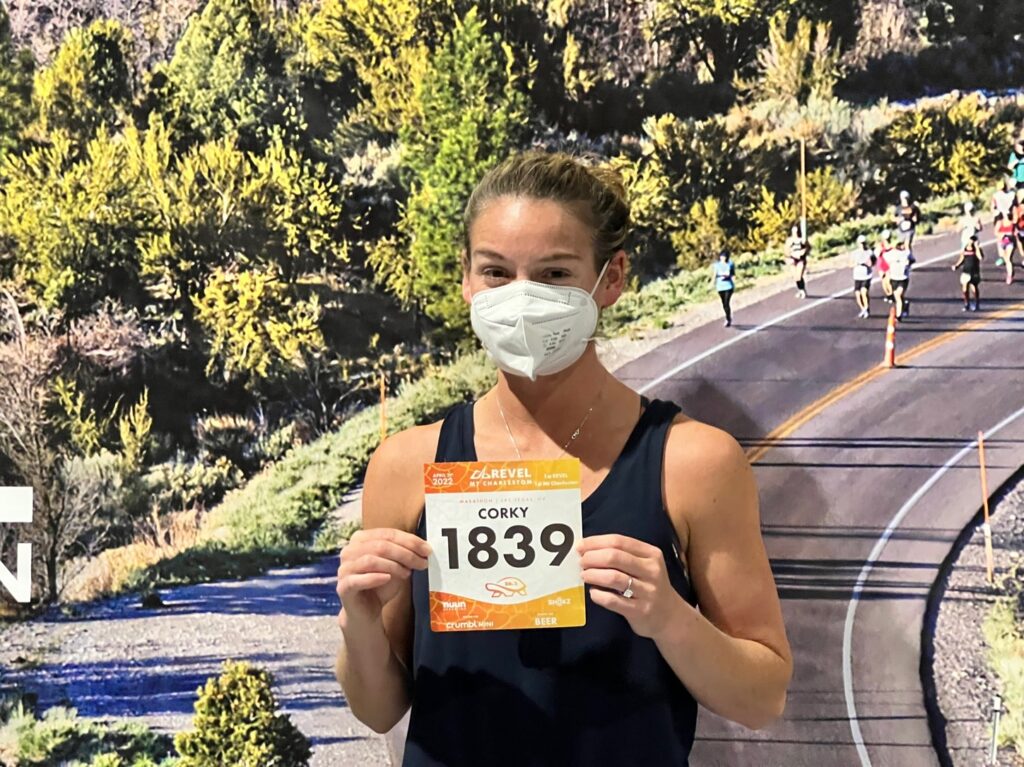
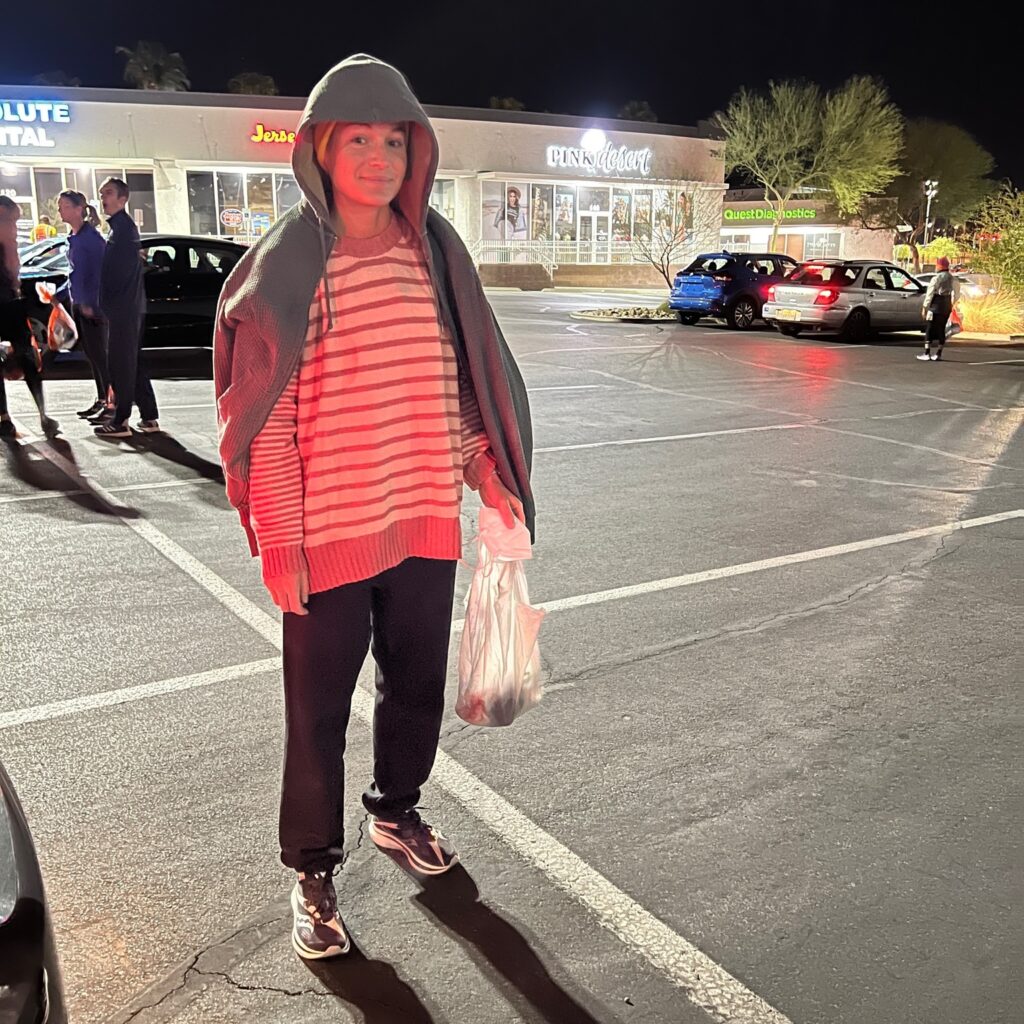
Breaking 3: Mount Charleston Marathon

If you’ve known me for long, you know that I’ve been on a quest to break 3 hours in the marathon since 2016. Between a few solid swings (3:03 finishes, multiple times), and then injuries, pandemic, etc – it felt like it would potentially never happen. However, sometimes patience and consistency truly do pay off, and I found myself ready to take my first swing at the marathon since 2019.

My original spring 2022 marathon goal was the Rotterdam Marathon, in The Netherlands. Known for a flat and fast course, with cool/damp weather, it felt like the perfect opportunity to take my chances. Training over winter went really well. I was running 60-65 mile weeks, with one double-run day, and my standard 3-5 days of strength training. No injuries, my speed was coming back – I was excited!

A few weeks before race day (3 weeks, I believe?), I began to panic: COVID numbers were creeping up again, and The Netherlands had just removed any/all COVID precautions. I began stressing about my first overseas trip since 2020 – would I finally get COVID? Would I get sick and get stuck in the Netherlands? To say I was stressing would be an understatement. The furthest thing from my mind was that 2:59, it was all the pandemic stuff out of my control.

I emailed my coach with my concerns, and suggested we find a state-side race instead that more or less fit the timeline. I was just about to knock out my last big week and then taper, so if I was potentially going to change the weekend, we needed to know asap.

After combing my favorite marathon databases, considering weather, course type, field size, accessibility, etc., I suggested the Revel Mount Charleston Marathon. To say that this race was an apple and Rotterdam was an orange wouldn’t do the comparison justice. Mount Charleston begins 7600 ft up, with a 5000 ft drop, with runners finishing outside of Las Vegas. I was considering a change in climate, altitude, and completely different demands on my body. However, I felt oddly confident that my legs could weather the endless eccentric contractions they’d endure on such an unforgiving course.

I don’t think my coach, Jason, was *quite as confident in this sort of course. They are incredibly risky, as legs can cramp or simply have nothing left long before the finish line. I was willing to give it a shot. I’ve raced well on hills – especially downhills. I train on rolling hills, and all of that strength training had to play to my favor.

So it was decided: Rotterdam would be replaced with Mount Charleston. I canceled travel, booked travel, and then we removed the last big week of training and I went right into the taper, because Mount Charleston was a week before Rotterdam.

Marathon weekend began the most frustrating way possible: flight delays that got us into Las Vegas after midnight. By the time we got to the hotel (we stayed on the Strip), and had dinner, it was 3am Friday. After what wasn’t exactly the best quality or quantity of sleep, my husband, Chris, dragged me out of bed and to my shakeout run Friday morning. While the last thing I wanted to do was leave the bed, I’m so glad he forced me to get up. The shakeout run felt heavy, slow and weird – but I felt much better after it.

After the shakeout, we picked up our rental car and drove to the race expo. The expo was easy to navigate, not at all crowded, and a smooth experience. Race day would include both the marathon and half marathon, but the vibe was very “small town race,” in the best way possible.

The rest of the day was spent relaxing, eating carbs, and shopping for throw-away clothes for the race start. Race weather was shaping up to be awesome: low 40s at the start, and then warming up to a sunny 65 degrees at the finish. Throw-way clothes are necessary for staying comfortable pre-race. With having to be at the shuttle bus at 3:30am, we were in bed early – though I don’t think I slept much at all.

My alarm went off around 2am. I told myself that jet lag was on my side. I ate a muffin and a donut with my coffee, and suited up in my race kit. With my throw-away layers on, we walked through the casino to the car. It’s very strange to be walking through the late Friday night Vegas scene, while you’re on your way to a marathon.

Getting to and onto the bus was very easy. The organization of the entire weekend was fantastic. I said goodbye to Chris, and snagged a window seat so that I could close my eyes and relax. Because the Mount Charleston course is a point-to-point race, and course runs through preserved land with few roads, spectators really aren’t allowed access the race course until the 20 mile mark. I knew Chris was going to be waiting for me at the finish. With my eyes closed, I relaxed my mind despite the buzz of nervous runners chatting. I could feel the bus climbing up and up, and as we neared the start area, snow lined the road.

Athlete’s Village was fantastic. There were fire pits for warmth, plentiful porta-potties, and tables with water and electrolytes. Despite getting there early (I’m always early to Athlete’s Village!), the time went by pretty quickly. I decided not to waste energy looking for the other two runners I knew who would be there. Nerves were low: I knew my strategy in pacing and fueling, and felt ready to execute my plan.

A few tips on this race: start slowly. You’re high up, so it’s possible that breathing will feel less than awesome. The course has a few ups in the first mile, so go by effort, allow your legs and lungs to warm up, and be patient. I packed salt pills as a last-minute decision, because Jason and I know I don’t do well in the heat. It was a guarantee that it would warm up, it was a matter of how quickly, and how well I could manage it. I took a pill within the first few miles of the race.

The race organization offers some incredibly detailed videos and breakdowns of the elevation of the race, so having done my homework, I knew mile 6-20 was going to be fast – and to be patient early and to dig deep late. I will caution that if a runner isn’t prepared for downhill running, or gets greedy and hammers this course, they may end up in a world of pain and having a disappointing performance and experience. With it being the desert, sweat evaporates quickly, making it deceptive with just how much one is sweating. Having raced a few times in the desert before, I knew I couldn’t go off of feel.

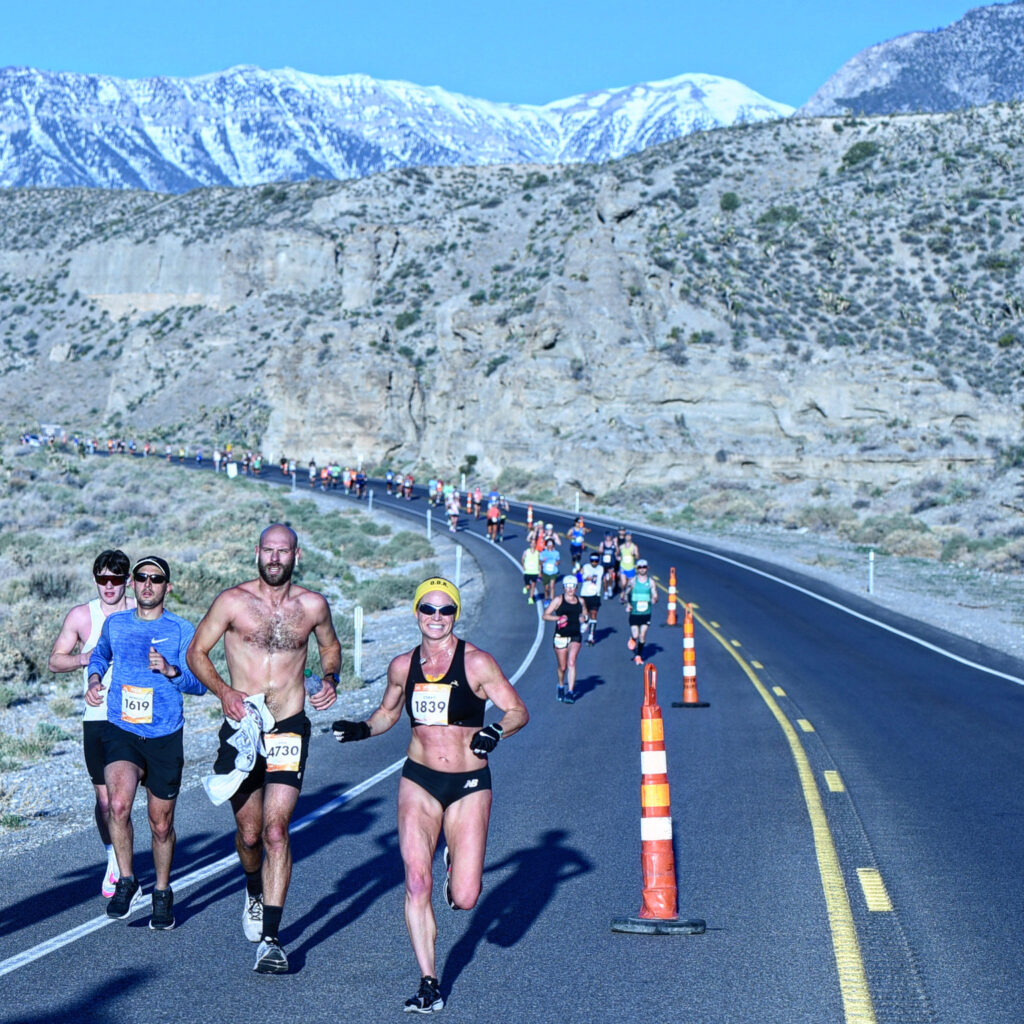
The race start happened right around sunrise, allowing us to finally see the beauty and drama of Mount Charleston. It was an incredibly picturesque place, and I recall wanting to soak it all in. Whatever nerves I had, and I hadn’t had many, turned to focus and fun within the first mile. It was cool and crisp, and I was happy to have my gloves, arm sleeves and head band on. I knew I’d peel them off as things warmed up, and was confident that my racing briefs and sports bra was the right choice.

With the exception of a few people who live on Mount Charleston, and the lovely volunteers at the hydration stations, there’s essentially no crowd support – just beautiful open space and the sound of breathing and shoes hitting the pavement. I found it peaceful, and dialed in my effort. While this quiet and remote marathon experience may not be for everyone, it didn’t bother me in the least. Perhaps having done much of my training solo over the years, and having done other more rural races, the quiet wasn’t jarring.

The first 6 miles or so include some serious downs, and a few ups. This is where I took a salt pill, and really began to understand how my legs would fair on the course, and what that meant in terms of pacing. For the first 6 miles, my splits were the following: 7:07, 6:30, 6:31, 6:33, 6:47, 6:35. I recall it feeling surreal: the combo of beauty, the hills, and how I felt – mentally I was in the zone, not thinking any more than I needed to, and allowing the miles to click by.

After mile 6, this race gets FAST. I forget the exact breakdown per mile regarding elevation, but the first 13 miles loses 3000 ft, and the second half loses 2000 ft. If the quads don’t die, and form for downhill running is strong, this can be a really fun race!

The following 6 miles felt effortless: 6:22, 6:24, 6:27, 6:34, 6:34, 6:35, 6:39. I reminded myself to never hammer, because risking my quads to bank time is a fool’s errand. Temperature began creeping up, and I was out of the shade of the canyon, exposed to the blue sky and abundant morning sunshine. In this stretch I ditched my arm sleeves and head band, though I held onto the gloves for a bit longer.

Around the half marathon mark, my stomach began acting a *little funky. Maybe it was the salt pill, or that I was getting my period that morning, but I became aware that I might need to make a bathroom stop. However, the stomach issue would come and go, and I decided at the mile 18 water station to be smart and use the port-potty. The splits from miles 14-18: 6:28, 6:33, 6:34, 6:36, 7:39 (porta-potty stop – which cost me about 60 seconds).

In my experience, if you need a bathroom and you take the detour, you’ll feel like a new person for the rest of the race. If I’d continued, stomach discomfort may have messed with my mind and my overall comfort. Well worth losing a minute to feel much better!

As the course nears miles 20, there is crowd support for the first time. This is a welcomed sight, as it was getting warm, and the elevation drop was less noticeable, meaning I had to readjust form and power after so much downhill to find my legs. It was around mile 20-21 that my right big toe became problematic. It felt like one moment I was fine, and the next I was being hit on the top of my big toe with a hammer with every step. I knew I wasn’t injured, but my guess was a blister had formed under the toenail. Between the force into the toe of the shoe, and this being my first race ever in super shoes (Suacony Endorphin Pros), and them being possibly a little on the small side for me, I had a good idea of what was happening.

I tried to be at peace with the pain – it was just a blister! But my form began changing and I briefly debating taking my shoe off and running barefoot for the final miles. Glancing at my watch, I was on pace for about a 2:53 finish – which was insane. I knew that I had to risk that time, and stopped on the course. I took off my shoe and sock, and took one of the pins from my race bib, in a harried attempt to puncture the blister under the nail and relieve the pressure.

A few kind half marathoners saw me, and offered me bandaids, but I politely said that the bandaids weren’t going to be helpful. After digging at my toe with the needle in an attempt to relieve pressure, I put the sock and shoe back on, and focused on moving forward. Splits from miles 19-24: 6:35, 6:41, 6:35, 8:17 (the rogue surgery mile), 7:15, 7:30.

After that little surgical delay, I struggled to get back to my rhythm. The toe was still painful, I could feel dehydration creeping in, and the course leveled out a bit. Plus, the final few miles of the marathon is simply tough! The last few miles took us runners through suburban neighborhoods. Having families out was nice, but boy did I miss the cool weather from the top of Mount Charleston!

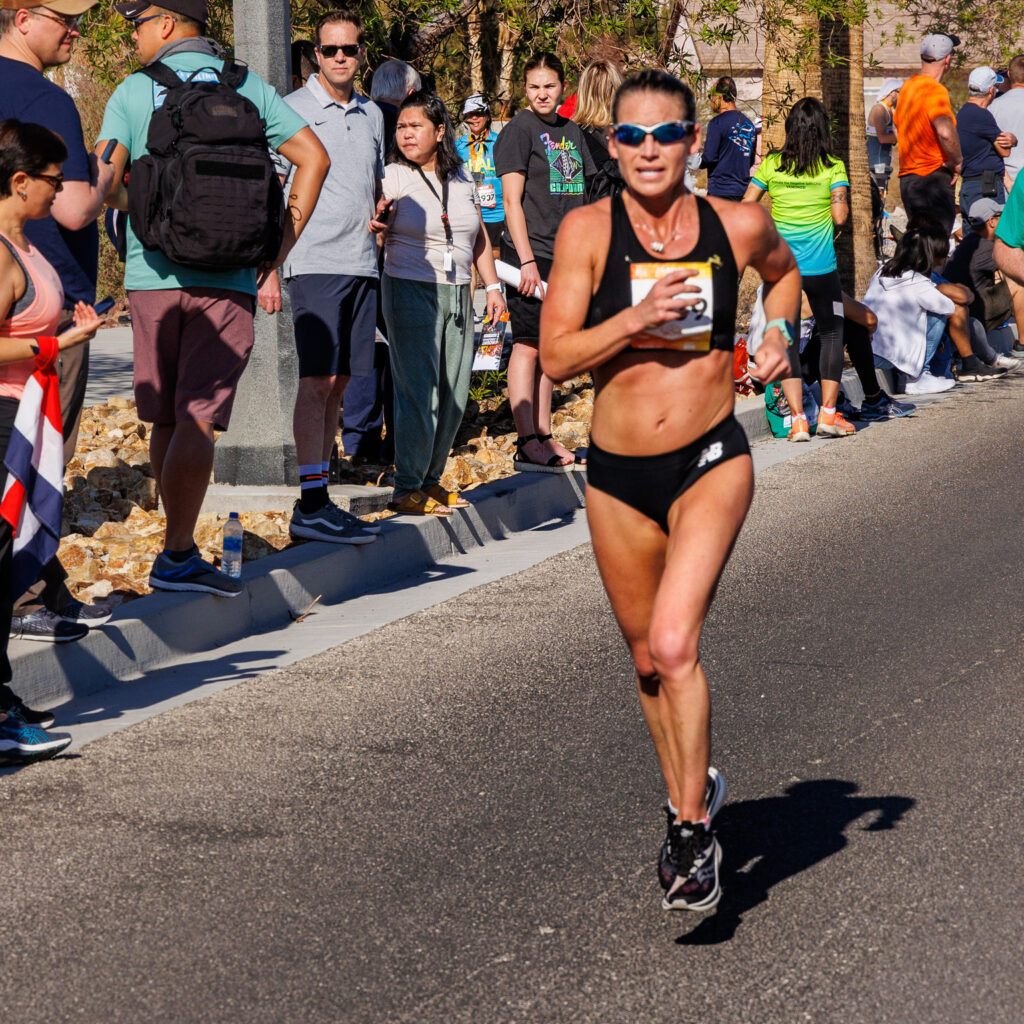
In those last few miles, I knew that unless something catastrophic happened, I’d achieve what I’d been chasing for years: a sub-3 hour marathon. Even with paces slowing, I knew it was there. The final 2 miles: 7:17, 6:59, and the last .2: 6:33 pace. There was a little uphill climb in the last mile, which honestly felt like Mount Everest to my legs. The only real turn on the entire course is right at the finish. It felt brutal to decelerate only to try to kick it in!

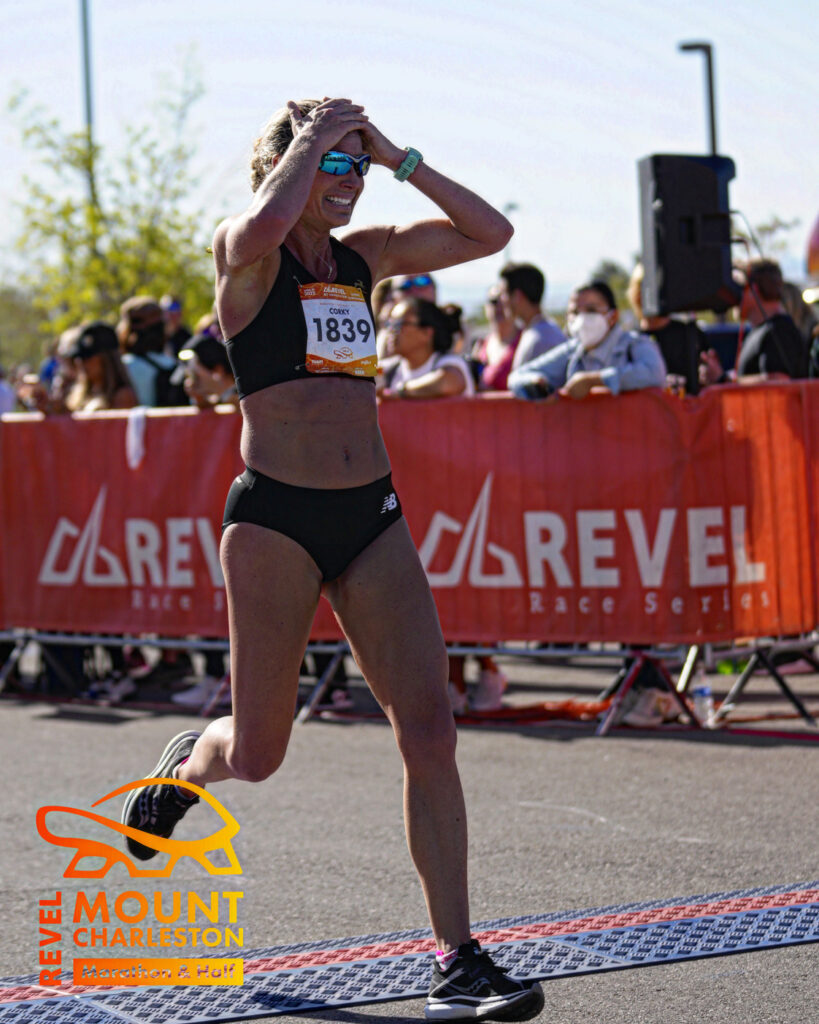
Official finish time: 2:58:15, and 6th place female.

Honestly, I was in disbelief. It’s really weird to chase something for so long, and then to have it be in the past. If I’m honest, I was actually momentarily disappointed with my finish, because without the bathroom and foot issues, it could have been an even faster day. It’s funny how often our minds go to that sort of place, instead of honoring an achievement.

The finish area was well organized and stocked with snacks. There’s nothing quite like chocolate milk after a marathon. It was 65 degrees and sunny at the finish, so getting in calories and liquid was a priority. It felt surreal to be around runners and crowds after the pandemic. My first marathon since 2019, close to 3 years from the date, and it felt foreign and amazing at the same time. In hindsight, I think the smaller race field at Mount Charleston set me up for success. Rotterdam would have been a very large, big city feel, and could have very easily overwhelmed me after so many years of social distancing.

You better believe I took my shoes off as soon as I could! After finding Chris, I walked barefoot for about a mile to the car. Despite the 5000 ft of damage done to my legs, aside from my quads giving me the indicator that they’d be angry in the coming hours, I felt really good.

Upon arriving back at our hotel, I was finally able to get a really good look at that big toe. The toe nail was black, a huge blood blister was under the nail. I was finally able to fully puncture the blister. Yes, it was disgusting, but it felt amazing to release the pressure. I knew that the nail was already a goner – I could feel that it was disconnected from the nail bed. Despite the pain out there, I’d happily sacrifice a toe nail for a PR!

The Revel Race Series provides free photos from the course, so it was fun getting those within days of the race. As an organization, my experience was nothing but amazing with Revel. Selfishly, I wish the race was a few weeks earlier or an even earlier start time, because it was hot for those final miles. Coming from training in NY winters, 65 degrees and sunny felt like summer. But weather aside, it was pretty near perfect.

In the days following this marathon, my legs were pretty darn beat up. In fact, I don’t recall ever feeling so wrecked after a road marathon. This reminded me of how I’d felt after Ultra marathons in mountains, not a road race of 26.2 miles. I needed more rest and recovery following Mount Charleston than any other marathon I’ve raced. That said, totally worth it!

If you are looking for a beautiful course, a well organized event, and thrive on hills – this may be a great race for you! Note that if you are not trained for hills, or need a big-city vibe, this race is probably not your jam. I don’t regret my decision to change race courses for a second – and the gamble paid off. Deep down, I’d love to go back and race Mount Charleston again – ideally without the toe issue! Could I go under 2:55 on this course? I’m definitely interested to find out.

…and the blog is back!

First off – holy moly – I cannot believe that it’s been almost 2 years since my last blog post! But honestly, I’ve been busy, and I didn’t feel I had much to really write about at the time. There’s just so much running content out there – I’ve already written a whole lot (here and for other platforms), and there are some pretty great running podcasts covering essential topics – so it didn’t feel worth cranking out new content “just cause.”

Consider this a quick “catch up with Corky” post, and then I’ll be blogging a bit about the two marathons I ran in 2022 (first ones back since 2019!), the benefits I’ve personally found from working with a coach, and more.

Like many runners, I found myself in a real funk during 2020. Between being furloughed, all races being canceled, gyms closed, and NYC being the epicenter of the pandemic, I lost motivation to do much of anything but keep my running clients motivated, and I watched a lot of documentaries on serial killers and religious cults. I also essentially ate and drank my feelings, leaving me physically and emotionally a shell of the person and athlete I was pre-pandemic. It took a LOT of hard work, patience, and determination, but I clawed my way back to feeling more like myself again.

So, what’s new? 

I am now coaching at NYC Equinox clubs, as of Spring 2021. Sadly the Precision Run Studio in NYC didn’t survive the pandemic, and so I was brought into Equinox to coach Precision Run and Elevate classes there. While it was a big adjustment – small business to LARGE business, having to run around to multiple locations within a day to be able to coach multiple classes, and pivoting to coaching on the floor in the club vs. a contained studio experience – but I’ve met some incredible people, and continue to be humbled to lead these classes. If you’re an Equinox member in NYC, come run with me!

With Equinox and Precision Run, I am still recording guided treadmill and outdoor runs – all available on the Equinox+ app. This year, David Siik and I created the first official training plan for Equinox/PR running content – a 5K program (again, all on the app). I have to say, it’s a pretty smart plan, and appropriate for runners of all levels.

In 2021, my partner (now husband!) bought our first house, which was pretty exciting. We’re now In Warwick, NY, which is a very cute and historic village. I’ve traded in urban running for running past cow farms, open space, and trails. I’m still in NYC at least twice per week, so you better believe I make the most of my time there between coaching to run my favorite parts of the city. The best (?) part of our house: we transformed the garage into a gym! I bought a refurbished Woodway Treadmill, and it’s decked out with tons of dumb bells, kettle bells, and even a cage for all the fun cable strength work. The gym is complete with disco lights, a beer fridge, and a life-sized cutout of The Rock – because he’s awesome!

I somehow made it in NYC without catching COVID until Spring 2022 – which felt like a weird victory. While my case wasn’t exactly mild, I’m thankful for vaccines and boosters, and that I was only seriously sidelined from life for a week, and from running for a few weeks.

My client roster in 2022 was the largest yet, and has been essentially capped/at capacity for over a year. There’s always a little ebb and flow, and I am grateful to be in the position where I am sometimes referring runners to other coaches, because I simply can’t take on anymore without compromising the work I provide my athletes – and I won’t compromise that. (That said, never be shy to send an inquiry!)

In 2022 I got married, ran two marathons, and have been reminded daily how much I love what I do. Runners are awesome, and it’s such a joy to support runners of varying experiences and abilities, all chasing down their goals.

Blogs on deck: I have two marathon recaps/reviews on deck – one was a big PR I’d been chasing for 5 years! I’ll share both my personal experiences, but also helpful info incase they are races you may be interested in running. I’ll also share my personal experience of what it’s been like working with my own coach for over a year, and a podcast episode we did together (he’s kinda big deal in the running podcast realm!). I have a few more ideas in mind, but also promise I will never “blog” for the sake of cranking out new content – so hopefully you find it helpful.

Cheers!

Corky

Ten Years a Marathoner – Thank you, Running!

Philly Marathon 2010. Mile 7 on Chestnut St.

This weekend marks 10 years since my first marathon – Philadelphia Marathon, 2010. This milestone truly has me feeling all the feels. I’m not sure if part of it is the pandemic and the pause on races, or simply the incredibly large role running now plays in my life, but looking back at where I started, what went into that first 26.2 training, and where I’ve gone – it’s quite the journey.

I want to start by saying THANK YOU. Thank you to a community, to race directors, volunteers, and fellow runners. I was incredibly intimidated of race culture and didn’t race for a long time because I didn’t think I belonged. Running and racing can truly be for ALL of us, and I’m so grateful the industry is so kind and supportive. A big thank you has to go to Ben Hauck, who was there in the very beginning. He never put a thought of doubt in my mind when I said “I’m going to run Philly Marathon, and qualify for Boston.” He nurtured my love for that first training cycle, and always supported my attitude of it being possible. An epic thank you to Chris, who has supported my running goals, career change to become a coach, and my insane undertakings like 24-hour Ultras in oppressive Philly summer weather. My family, few of whom identify or understand the bizarre world of racing, for continuing to support me and my quest for what makes me happy. [Read more…]

Motivation and balance in a pandemic world

As athletes, we are constantly balancing load and capacity – the training for goals and the external factors. When the balance is off, injury risk rises, athletes burn out, and fitness tends to plateau. One of the priorities of the coach: keeping things in balance so that the athlete can achieve their goals. The challenge: some of the capacity will depend on personal scenarios to that runner. The coach and athlete have to be communicating so that the balance works.

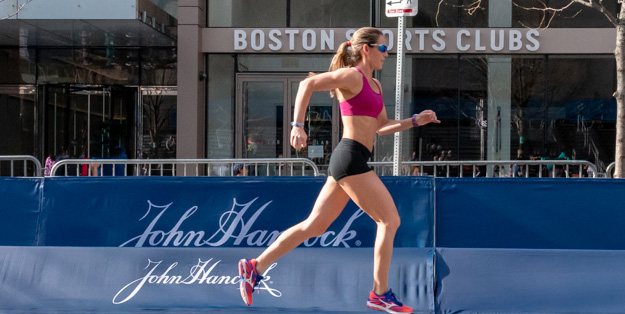
This is why (and I cannot stress this enough), using a cookie cutter plan online or bumming your friend’s training plan probably won’t serve you well, and can actually harm you. A coach is constantly adjusting things based on the feedback and communication from that athlete. This is also why it’s paramount you communicate with your coach – them seeing data without knowing how the workouts are feeling is only sharing part of the picture.

Here are things your coach (and you!) should be working on:

  • Building mileage and fitness for the goal
  • Consistency in training – locking in a plan
  • Building strength and running economy
  • Getting rest to allow for super-compensation
  • Keeping injuries, aches and pains at bay
  • Maintaining an element of fun
  • Confidence and mental strength grow as fitness improves
  • Educate athlete on training principals, fueling, pacing, etc.

Here are the possible challenges that will directly impact the above:

  • Stress/anxiety in the personal life
  • Poor sleep (less than 7 hours is proven to be where adaption will be compromised)
  • Illness
  • Poor nutrition (not getting enough calories or the right things)
  • Lack of focus and commitment (could be caused by stress, a few bad workouts, and more)

This year, without in-person races but with a TON of added stress for the mass general public, perhaps this balance is harder than average to control.

While I hope your life hasn’t been seriously impacted by the pandemic, I think it’s safe to say all of our lives have been touched by now – losing a loved one, losing a job or reduced salary, change in lifestyle (social life, theater, sporting events, bars/restaurants), losing your training routine (maybe a gym, group fitness class, running group), losing all race goals, simply stressed due to the political climate – and if you’ve checked each one of those boxes, the odds are good your sleep sucks and you’re living through anxiety.

Running (and fitness in general) has been championed as a mood enhancer, stress reliever, and emotional outlet. But if you’re not sleeping, you may notice your fitness performance has been compromised. It’s a cyclical problem – you need sleep to run well, and running regulates sleep habits.

If you’re shaking your head that this is personally resonating, my advice is to take in a big inhale – and then a VERY big exhale. This reality isn’t normal. Sometimes just doing your best has to be enough. Let go of a speed or distance goal, and allow running to simply and purely be a source of joy. The external stresses as of late are well beyond anything we’ve navigated before, so don’t be so hard on yourself.

A coach is a good person to discuss these challenges with, and they may be able to restructure your calendar and expectations of the workouts. Right now, we need running more than ever. Though the role may need to change temporarily.