The Twelve Myths of Fitness – Day 3: There’s a perfect running shoe

I am asked all the time for my advice on the perfect running shoe. It’s one of the most common questions my private clients and runners at the studio ask me about. Sadly, the answer isn’t so easy. There is no perfect running shoe for everyone. However, that doesn’t mean there isn’t the perfect running shoe for you, because there probably is. But it will be a completely different shoe from the next runner.

It can be overwhelming to shop for a new running shoe. Especially if you aren’t happy with your current shoe, or your current model is being discontinued or remodeled. Once you find the right shoe, it’s like magic. Nothing should hurt, and the shoe should almost feel like an extension of your leg or foot.

There are dozens of running shoe brands out there. You can probably name at least a couple off the top of your head. Now, each brand has there own line of shoes – models varying in support, weight, shape, terrain, for runners who pronate, runners who supinate, and runners with a neutral landing. Some runners are incredibly light on their feet, while others are quite heavy. Some land front or mid-foot, while many heel strike. There are also trends in shoes – from the minimalistic trend (hello, Vibrams and Nike Free) to the maximus trend (hello, HOKA ONE ONE) – and each brand usually embraces those trends and markets towards them. It’s enough to make one’s head spin.

So how do you find your perfect pair? Bring your old running shoes with you when shopping for a new pair. The wear and tear can give some clues regarding your form and needs. A gait analysis can’t hurt, if you are completely confused. However, I find many of us run “differently” when on a treadmill vs. outside, or when we know we are being analyzed and video taped, instead of what we naturally do while out on our own, especially as we fatigue and form/stride can be compromised. Speak up about aches, pains, and injuries. These can also be helpful clues. And finally, listen to your body. The shoes should feel good. Maybe even great. If they don’t, they aren’t right. Maybe not the right brand, or simply not the right style – and that will be true in all brands across the board.

Lastly, please change your shoes frequently. Shoes can wear out quickly, especially if you land heavy on your feet, carry extra weight, or use your running shoes to walk and stand. It’s far cheaper and easier to replace shoes than to deal with doctors and physical therapist appointments. And remember, you are shopping for function – NOT fashion.

The Twelve Myths of Fitness – Day 2: Running is bad for your knees

If you are a runner, you’ve probably been asked this a thousand times: Isn’t running bad for your knees?

And if you’re not a runner, perhaps that’s your belief or assumption. In general, the answer is no, running is not bad for your knees. That’s an old wives tale. In fact, I’d argue that it’s in fact good for your knees. However, we are all different. And so is running good for your knees? That depends. Here’s a NY Times article discussing why runners don’t tend to get arthritis in their knees.

Any highly repetitive activity can have consequences. Overuse is a common issue for many athletes – be it a basketball player jumping, a tennis player and their elbows, or a dancer and their hips. Doing something repetitive day after day, year after year can cause problems. However, when supplemented with other activities, done wisely, and with good genetics, running can keep humans active, agile, strong, and enjoying a sport they love way into their golden years. While I’d argue running isn’t bad for many of us, I’d also argue that many runners don’t supplement their running wisely or train in a smart manner.

Statistically, many runners overtrain or train with little purpose or guidance. Many runners also don’t respect their body’s need to recover and rest – be it rest days during the week, or taking some significant time off after completing a big goal race, like a marathon. In fact, I’d argue most runners are pretty stupid when it comes to their training choices. I’d be the first to admit I’ve made those mistakes and learned the hard way. Sometimes runners simply don’t know any better, or they have FOMO and cannot force themselves to take time off. I’d also argue that most runners don’t strength train or cross train enough. So a flawed training schedule or plan can lead to angry knees, hips, shins, feet, tendons – the list goes on. So if a non-runner asks the average runner about their injuries or knees, they may hear their opinion on knees and running validated.

It’s important to understand that body weight, shoes, form, and running surfaces can also be factors in how happy your joints are with your weekly miles. I’ve found many of my runners with a history in martial arts and track and field events like long jump tend to have issues with running and keeping their knees happy.

If you still aren’t buying the whole “running is good for my knees” concept, here are five expert opinions. For many of us, the benefits far outweigh the possible damage or consequences of running. Just remember that you only have one body, and you should run, train and race with the big picture in mind – active decades to come – not just your races on the calendar this year.

Post-Marathon Advice

corky_fitness-2642finalwsharpeningflatwebSo you just ran your goal race for the season, and are riding a high and eagerly filling your calendar for next year. First, congrats! It’s an exciting feeling to finish your goal race – especially a marathon. It’s also common to set new goals, get excited for the future, and get back out on the road to get back to work!
Relax. Rest. Recover. Most marathoners jump back into running or running hard way too soon after their goal marathon. I understand the excitement. And many runners get nervous they will lose the fitness they spend literally months building. The idea of taking a few weeks off sounds unacceptable. There’s a fun half marathon in a week or two. There’s that Turkey Trot – I can’t possibly miss it!!!! Yes. You. Can. You need to remember a few things after crossing that finish line. The choices you make in the few days/weeks following that goal race can have huge implications on your future as a runner. I know, you may feel decent. But that doesn’t mean your body is actually recovered. In fact, injury risk is extremely high after a goal marathon, and immune systems usually drop briefly. This is your prime opportunity to get sick. Or injured. And you may not feel injured until a few months from now.

It’s a blessing but also a curse to have so many races hosted every weekend. The feeling of missing out, skipping an opportunity, not running with friends – I get it. But it usually isn’t worth going and putting your body through stress when it isn’t ready. The consequences could mean being forced to stop running for a few months or even a few years. And don’t underestimate mental burnout. Your brain needs some time to rest, reset and be on board to train for your new and exciting goals.

Maybe now you are on board with the recovery for a few weeks, but not happy about it. Okay, here are a few tips and things you can do to enjoy this time while losing minimal fitness and staying active in the running community:

  • Volunteer or go cheer at upcoming races in your area.
  • Ease into some easy cross training a week or two after your marathon.
  • If you dealt with injuries during training, address them now. See a doctor or physical therapist. Address weakness, tightness, and habits. We all have them.
  • Revamp your nutrition and cut back a bit on all those carbs and focus on fruits, veggies, lean proteins – try new recipes and have some fun in the kitchen!
  • Maybe try yoga, pilates, and a weight training routine during your recovery.
  • Catch up on sleep, your social life and any projects that were on the back-burner while marathon training.
  • Throw a party to celebrate your achievement! You may inspire a few friends to run the next year.
  • When the dust settles, write about your race experience. What worked well, what was tough or a mistake, and be honest. Your running journey will adapt over time. Learn from each race.
  • When you ease back into running, do it with no pressure or expectations of time. leave the watch at home and go by effort and simply enjoy the miles.
  • Trust that your body will bounce back and loss in fitness will be minimal, while injury risk will be extremely low and your body and brain will be ready to dive back into working hard.

Congrats again on your recent achievements! Now recover. As I say to my athletes, the rest and recovery is just as important as the hard work. Now is the time to really embrace that process. I want you clocking happy, healthy, and strong miles for years to come.

Running Injuries, Goals and the Gym

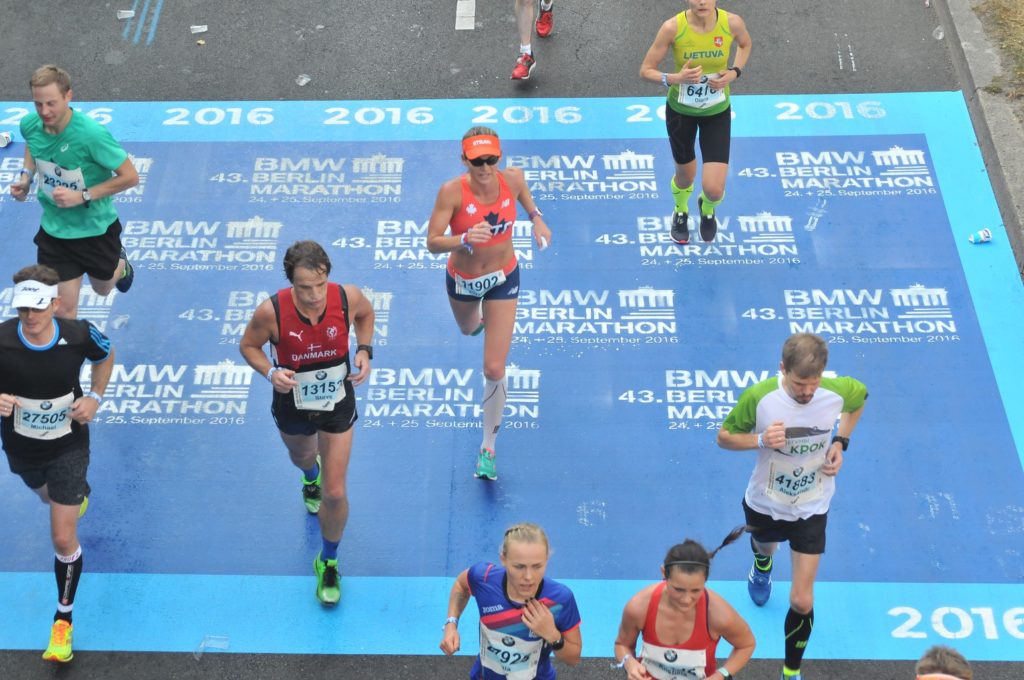
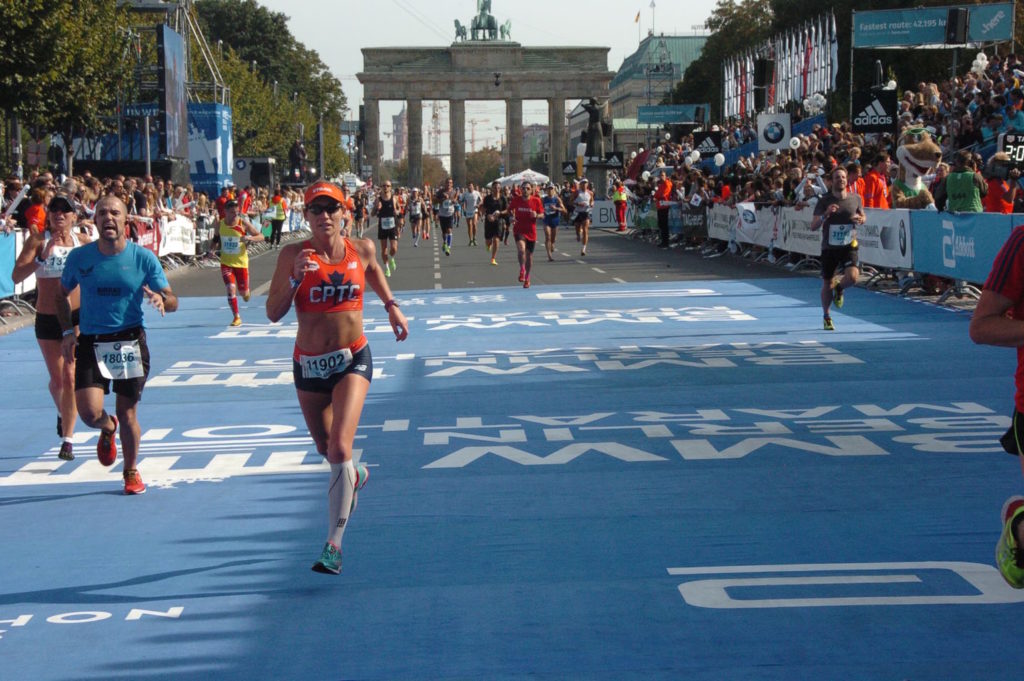
Berlin Marathon. Low mileage, lot's of time in the gym. Pretty good PR - 3:03:30.

Berlin Marathon. Low mileage, lot’s of time in the gym. Pretty good PR – 3:03:30.

It’s that fun time of year when there are literally dozens of races every weekend – from small 5Ks and 10Ks to some very large half marathons and marathons. The running community is filled with taper nerves, stories of recent race experiences, and reflections and goals for the new year. It’s a pretty awesome time to be a running coach and to watch the weeks and months of careful planning and training begin to pay off with some really incredible race finishes, personal records, and lessons learned.

I find that the journey can vary quite a bit per person. We are all different, and we adapt to training, goals and work load differently. I couldn’t help but notice while I was out for an 8-miler today how many runners I passed with medical tape, braces or bands on their body. It made me a little sad, angry, ad motivated to blog about it. In the non-running community, most people still assume running is bad for our knees. In fact, I cannot count the amount of times an acquaintance or total stranger says something negative about running and joints when they hear I run and coach runners. In fact, quite the opposite is true.

This isn’t to say that repetitive wear and tear doesn’t have consequences – cyclists, swimmers, dancers, tennis players – each sport has it’s own chronic injuries due to the muscles, tendons, ligaments and joints used repetitively. However, when done the right way, we actually usually stay far healthier and active when we use our body instead of sitting on our butts. Can running mess up knees? Sure. That will vary per athlete, their genetics, history, form, training practices, and overall strength. I come from the philosophy where most injuries are preventable, and most runners you see taped up simply didn’t train well. Usually they took on too much too soon (mileage or stress), or are incredibly imbalanced and could benefit from some serious strength training, cross training, stretching – or all of the above. Most injuries are preventable. Some obviously are not, and require immediate medical attention, and the diagnosis and advice should not be ignored.

Here’s the funny thing – most injured runners will willingly admit how much they are in pain, or how much their potential has been compromised, but yet they won’t take the necessary time off to rehab and recover. As a coach, I cannot help someone who isn’t willing to take the help. That may be the toughest part of my job. Knowing what needs to happen, but having an athlete unable to accept the work load, recovery, etc – to get there.

And so after witnessing all of those taped up runners today, I thought about myself and my running. I haven’t been injured (thankfully!) since 2012. I was forced to take 8 weeks off from running back then, and it was the worst two months ever. I swore to myself I would do what I could to avoid the injured list in the future. And so I finally began to take my own coaching advice. I also began to really listen and learn from my body. Dare I say, I began to train smart. Even when clocking 100-mile weeks while Ultra Marathon training in 2014, I quickly learned I needed to eliminate all speed work and simply focus on mileage. And when I shifted back to shorter and speedier goals, I cut mileage way down, and spent just as much time weight training as I did running.

In fact, that’s what struck me today. While training in 2016, my mileage was lower than most years in the past, ranging from 35-60 miles per week – including when marathon training. I’d cap my runs to 5X per week – no more, and 2 total rest days. I also spent a ton of time lifting heavy in the gym – upper and lower body – 2-3X per week for each. And for me, that combination lead to two of my three fastest marathons ever, within a 6-month span, and minimal aches and pains and no injuries.

And not only did the above combination work for me, I made myself be incredibly smart and conservative when hopping into any other races. Did I miss out on some incredible race opportunities this year in NYC? Absolutely. Did I have regrets or FOMO? Sure. And peer pressure is a bitch. But somehow I stuck to my guns, and my goals were clear. And so I didn’t add anything potentially harmful to the big goals.

Not every runner can spend hours in a gym. Or many simply don’t want to or refuse to prioritize their time. I get it. If you are very busy and love to run, you want to spend your free hour running – not in the weight room or on an elliptical. You want to be outside in the open air. I can totally relate. However, if you start to think about the longevity of your running career, and the specificity of your goals, you may start to view your training and choices a little differently.

So when you hit your off season, whenever that might be, I encourage you to take a hard look at your running and training history, and how your body has responded. Are you healthy? What hurts and why? Were your time goals achieved? How do you mentally feel? Listen, learn, and adapt.

Race Recap: Berlin Marathon


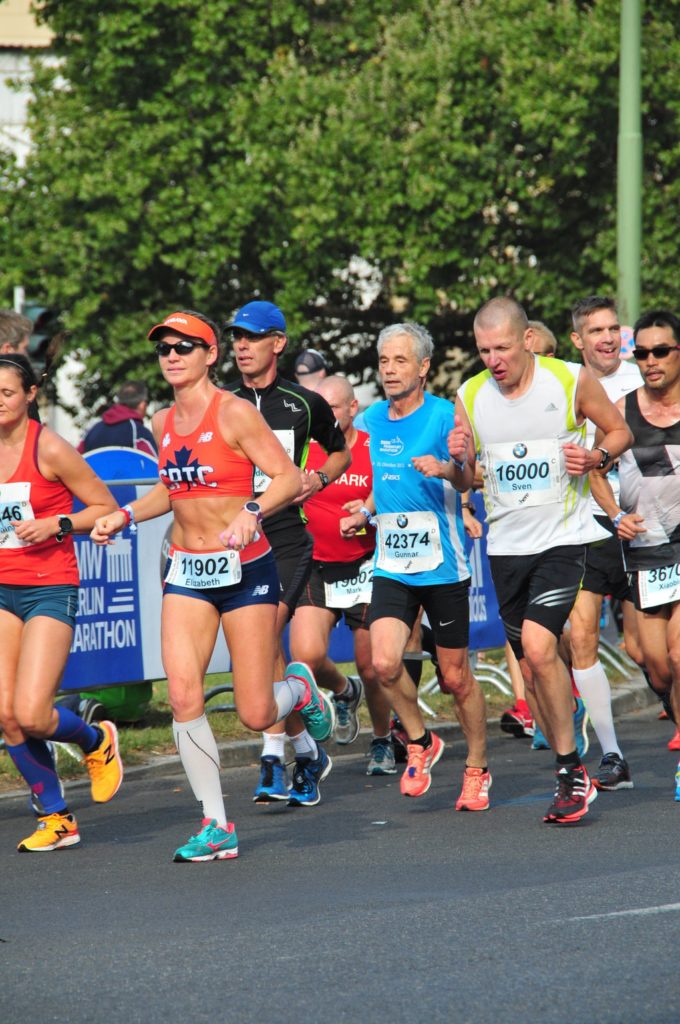
Early in the race. Feeling relaxed.

Early in the race. Feeling relaxed.

Berlin Marathon had been on my radar since I was notified I’d been selected via lottery back in December 2015. With a reputation for being the fastest marathon in the world, I knew if I went to Berlin, I’d go to race – not to simply run. This would mean training to race my first marathon since 2013. So over 10 months ago the goal was set: race Berlin 2016, aim to break 3 hours, or set a new PR.

The road to Berlin wasn’t easy. Some days or weeks would click into place. Others were a struggle, and filled with doubt. I questioned my decision to coach myself on more than one occasion. There’s a reason why many coaches hire someone else to coach them – it’s hard to be the student and the teacher. I questioned my potential. Was my 3:05:27 back in Philly 2013 as good as it gets? But doubts never lead to anything good. And I knew my training was smart. So I’d try to shake those doubts and focus on the good and great workouts. Just like bad weeks of training come and go, so do good ones. Neither one defines us. I am thankful to be surrounded by some incredibly supportive people. Friends, coworkers, team mates, family – people who understand or at least respect the grind. My roster of private athletes have cheered me on. And so when the going would get tough, I’d remember to lead by example and continue to grind away. By the time I got to Germany, I knew all I could do was trust my hard work and preparation, and have confidence in that.

I had never been to Berlin before. It’s a really beautiful city. I was oddly calm about marathon morning (I’m usually a basket case), and was actually capable of enjoying the city for a solid 36 hours before race day. The day before the race was spent walking at least 4 miles around the city, and a 3-mile shakeout run that evening. I ate pasta with a German beer, laid out my running gear, and that was it. Was I nervous? Sure. But I was also calm. I accepted that it was going to be 3 hours of work, and that I was ready.

The weather race morning was perfect. Cool and sunny, with no breeze. The marathon gods were good to us. As I stood in my corral, and the announcers counted down to the started, I began to cry. I was overcome with the power of the moment. The amazing park. The
40,000+ other athletes. The opportunity before me. I quickly collected myself, and within a few minutes I was across the starting line.

The course is fast. And there’s a blue tangent line on the course. I decided I’d stick to that line as though it were glue. This was the first marathon I’d ever run with no mile markers (only kilometers), and I was one of few athletes around me who’s watch would go off at the miles. I told myself to stay relaxed and efficient. I hydrated early and often. Around the 20K I saw Vinnie, and that was like a kick of energy. In an unfamiliar city, a familiar face was priceless. Around 17 miles into the race, I felt amazing. Pacing was good. I felt that a sub-3 was going to require a kickass final 10K, but a PR was mine to lose.

535044_237057350_xlarge

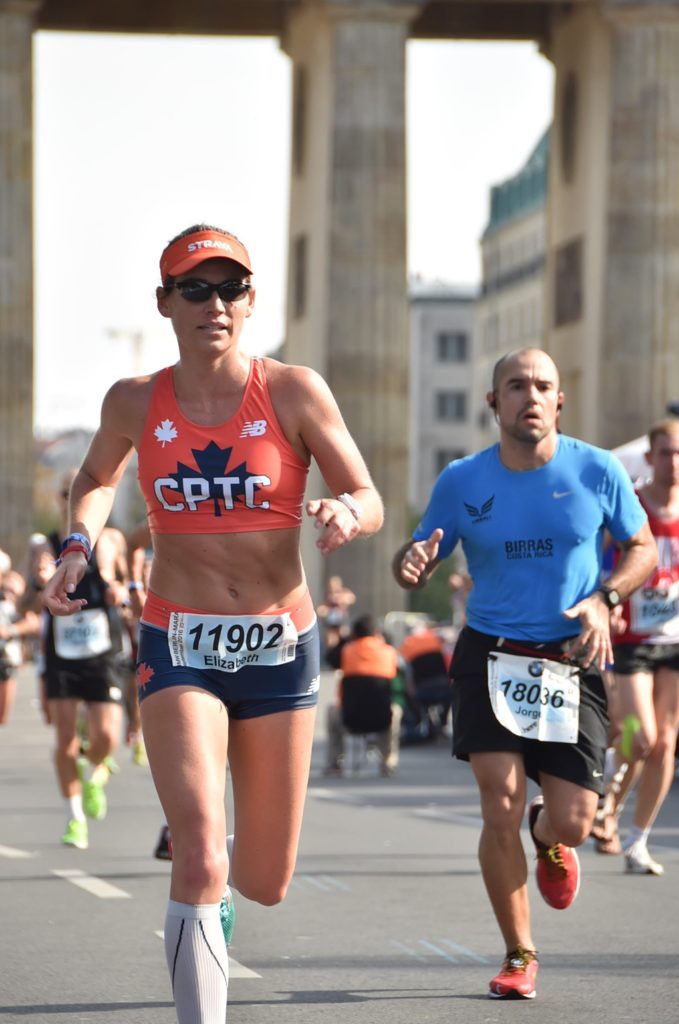
Eye is on that clock.

Then around 19-21 miles in, a few things happened. One, I began to cramp. Not runner cramps, but lady cramps. The kick in the uterus feeling, on my right side. In the beginning it was relatively dull, but as the miles went on that changed. I was incredibly mad at myself, as I had planned to take ibuprofen that morning (I’d had cramps off and on for a few days), but that morning had felt good and I opted to go it without precautionary meds. And then the nausea and gag reflex to GU began to happen. It was a burp that turned into a “Oh no, I just kinda threw up in my mouth” moment, and this was before I needed to take my final GU around 20 miles. I forced that final GU down, but it wanted to come back up. The final 5 miles were a painful negotiation. I debated stopping for a break and to try and regroup. I debated walking off if Vinnie were at the next turn. My body was struggling and my brain wasn’t giving me the ability to simply pick up the pace.

I told myself to do what I could. If I lost my PR, it wasn’t the end of the world. Just do your best. Just finish this. And so I continued. Paces slipped. I walked through a hydration station in the 23rd mile, hoping that brief pause in running would help the cramps. It made it worse. And so back to running I went. My eye on the clock, I took it one mile at a time. I saw Vinnie around 24 miles, and I mumbled something about this really hurting as I pointed to my side. He ran beside me for half a block, yelling encouraging things, to which I told him to shut up and stop lying. And so I continued.

The final 600M of the Berlin Marathon is spectacular. I think. I don’t really remember. The final stretch was lined with people. I focused on the clock. You can see the finish line a long ways before you get there. Glancing at my watch, I knew a PR was in the cards, but by how much – I wasn’t sure. Just finish this. Just get there. Just get this done. That’s all I could think about. Crossing the finish line I felt relieved, tired, emotional, and still in pain. The nausea was thankfully replaced with hunger by the time I got back to the hotel. And I took ibuprofen immediately to kick said cramps to the curb.

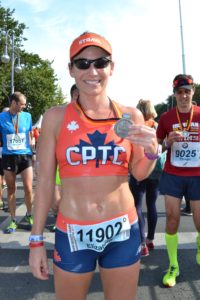
The rest of the day was filled with walking around, beer and food. I am in shock (and a little mad) at how good my legs felt after that marathon. There was so much more left in them to give. But they couldn’t have their day. My disappointment didn’t last long. How can it? I did the best I could that morning. And yes, I walked away with a PR. That PR, that much closer to 2:59:59 – it makes me that much more hungry for it and that much more confident it’s in me.

Here are the official stats:

535044_237095576_xlarge

Finish time: 3:03:30 (average pace: 6:58s)

100th female (11th American)

Splits:

Mile 1: 6:50, Mile 2: 6:51, Mile 3: 6:56, Mile 4 :6:58, Mile 5 : 6:51, Mile 6 :6:57, Mile 7: 6:49, Mile 8: 6:52, Mile 9: 6:53, Mile 10: 6:48, Mile 11: 6:51, Mile 12: 6:52, Mile 13: 6:49, Mile 14: 6:53, Mile 15: 6:54, Mile 16: 6:54, Mile 17: 6:57, Mile 18: 6:59, Mile 19: 6:55, Mile 20: 6:57, Mile 21: 7:07, Mile 22: 7:02, Mile 23: 7:13, Mile 24: 7:30, Mile 25: 7:12, Mile 26: 7:17, .34 miles: 2:13.

A few tips for future Berlin Marathoners:

  • Stay at Hotel Adlon Kempinski. It’s worth the money. Not only is the hotel gorgeous, quiet and comfortable, but it’s literally at the Brandenburg Gate – a very short walk to the start/finish lines and on the marathon course.
  • Make morning preparations the night before. It turned out the hotel had some food/coffee for marathoners in the lobby, but no coffee shops open before 8am (some 10am) on Sundays. I bought a bagel and coffee from Dunkin Donuts the night before.
  • The expo was a mess. So go to it patient, and ready to get in/get out. I couldn’t have really shopped for anything if I had wanted to.
  • Be sure to plan to use your own fuel. The drink and fuel choices (which included Red Bull) on the course were new to me. I stuck to water the the 4 GUs I brought.
  • When planning your trip, account for jet lag. It’s not every day I run a marathon at 3am. Do everything you can to get on schedule before race morning.
  • Go for your shakeout runs in the Tiergarten. That park is the most stunning thing ever. 535044_236930700_xlarge