
Springing into Action

It’s the time of year where many runners who hibernate during the dark and cold Winter months take their first few miles of the year. It’s also the time of the year for Newbies! Perhaps inspiration from a friend or family member, a stress in life is forcing a change, something has sparked the interest in the sport – new runners are testing out their running legs. If you’re new and flirting with the idea of running, or you’re coming back from a serious hiatus, here are some tips and tricks for getting started.

  • Check your shoes. If they are over 6 months old, you’ve used them for walks or time in the gym, or they don’t feel supportive or fresh anymore, get a new pair! Your feet are important. There is no “magic” shoe. Just see what feels right to you. Most decent running shoes will run you about $85-150.00.
  • Start where you are! It can be humbling for the first run ever, or the first run back after some time off. Aim for 20-30 minutes out there. Maybe it can’t all be a run. Maybe it can. No matter what, go at an easy/moderate effort. It’s important to ease into the sport.
  • Avoid cotton socks. Blisters can plague runners, but cotton socks are usually a leading variable. Running socks are a bit more expensive, but worth the investment.
  • Lots of runners want to know their data – how far they went, how fast, elevation, calories burned, heart rate, and so on. If that sounds of interest, I’d recommend investing in a running watch. You can find gadgets between $100-700.00 – depending on how high-tech you want to get. There are also a dozen or two apps you can download on your phone. I find the apps to be less accurate, but it’s a cost effective place to start – especially if you don’t know what your relationship with running will be.
  • Recruit a running buddy to help with accountability and reduce pressure in speed or distance. Focus on simply making running a consistent part of your life for 3-12 weeks. Run with a furry friend, push the stroller, simply build a habit and allow your body to slowly adapt.
  • Don’t compare yourself with anyone else. Your journey with running will be uniquely yours. Your paces, body, mental capacity, preference in route and weather – embrace all of it and own it.
  • Set realistic goals and expectations without dismissing your potential. It’s important to accept where we are at that time. For example, signing up for a marathon 18 weeks out from the 1st run of your life or in months is not advisable. But is a marathon 12 months from now? Sure! And can a 5K or 10K be a realistic and attainable goal in 18 weeks? Definitely. The same could be true with setting the goal of running without stopping around Central Park – for example. But can you run to Battery Park from Riverdale? That’s a bigger goal and realistically would take more time. The sky can be the limit, but maybe not by tomorrow.
  • If your schedule is stressful, add your runs to your calendar. Make gym dates to stretch, cross train or weight train. If you know you’ll be most successful at consistency if you run before work, plan to always run in the morning and start your day off right. If you thrive on a lunch time run, lace up and get in that afternoon sunshine. Set yourself up for success. Reduce obstacles.
  • Accept that your running journey can change and adapt. This doesn’t have to be a serious sport. It can be fun, a stress reliever, or whatever it is you want. It can be a lone experience or a social activity. It can be incredibly competitive and driven. Make it yours!
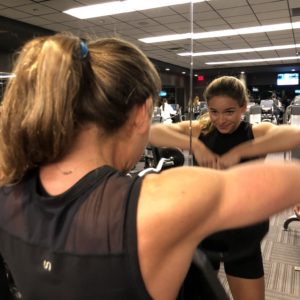

How to Maximize a Small or Limited Gym

Rocking out a workout at the Mirage Hotel gym in Las Vegas in February. Day after my Half Marathon win and PR.

While away for my sister’s bridal shower weekend last week, I stayed at a Holiday Inn Express. I posted a couple stories on my Instagram at the time, showing the incredibly tiny gym and the minimal options I was presented with for weight lifting. I decided this is a great topic for a blog, as many people travel for work or leisure, and don’t want their routines interrupted. This may also be helpful if you have extra space at home and are looking to create your own personal gym.

When weight training, you really don’t need much. This is assuming you know how to utilize free weights in a meaningful and safe way. The benefit to weight machines is that form is somewhat guided, so creativity doesn’t need to be high, and most moves are supported. Weight machines take up a ton of space, so many older hotels or ones with tiny gyms won’t have them.

If you have room and access to a bench, a mat, and a stability ball, along with a healthy assortment of free weights (dumb bells and/or bar bells), you can get in a fantastic weight training session.

Utilize the mat for pushups, planks, core work in general, and stretching.

Utilize the floor for squats, lunges, upward row, deadlifts (if there’s room!), overhead shoulder presses and bicep curls.

Utilize the bench for bench press, skull crushers, dips, step-ups, bent-over row, and incline press.

Utilize the stability ball for hamstring curls, knee tucks, and stability chest press.

Utilize the weights whenever possible over simple bodyweight work for a more intense workout and greater payoff. If you have a nice weight range, you should be able to challenge and exhaust pretty much everything head to toe.

If creativity is low, or you have questions on form, there are tons of Youtube channels out there with decent demonstrations and tips. Training while traveling can be a challenge, but it can also be a new adventure! Unlike my hotel experience last weekend, my recent hotel experience in Las Vegas at the Mirage was a pleasant surprise – it was really awesome. Everything you could imagine and more! Make opportunities instead of excuses, and your training will rarely get off track.

Running by Exertion

Running out of one of the tunnels, Saints and Sinners Half Marathon 2018.

Runners are often caught up in numbers. We measure our runs by distance or time, and often chalk the success of a run or determine our fitness by our paces. While numbers should certainly play a motivating and informative role for many runners, it’s important to listen to our bodies. After all, a 10:00 minute mile may be a sprint for one runner, a tempo pace for another, and a recovery pace for a third. While 10:00 minute miles will always equal 6 miles per hour, what that pace feels like will vary per person. And that’s incredibly important – especially for newbies or runners coming back from a hiatus or injury.

Despite all the cool techie gadgets, our bodies simply understand exertion or effort. It’s important for us to be able to honestly feel our efforts and listen to our bodies. Most weekly runs, regardless of talent or speed, should be done at an easy/moderate effort. Most miles should feel low stress. That effort will give us all different numbers. That number may also greatly swing one way or another based on weather, altitude, sleep, nutrition, and so on. Perhaps one of the greatest mistakes most runners make is running too much at an effort greater than prescribed. I’d be the first to admit that for years I’d run my recovery runs too fast, and then I’d be wiped out and cooked before I’d even start a speed workout.

Learning to listen to our bodies and understand our efforts takes consistency, time, practice, and self awareness. I recommend runners ditch the music whenever possible, so that they can tune into their body, form, breath rhythm and run without distractions.

It’s also important to remember that our devices can crap out. While GPS watches and apps. can give us useful data; buildings, mountains, tunnels, and simply bad weather can mess with our device. If you are 100% relying on that device, your workout or race could greatly suffer. It sucks when technology fails us, but there should be a calm confidence in knowing your body as a runner.

For my new runners, I try to stress the importance of exertion. For one thing, we are completely shooting in the dark if I tell a new runner to run 10:00 minute miles for their first run. That number could be way off base and inappropriate for them. Instead, go for a run and keep the exertion to comfortable/conversational, or a 4-6 out of 10 exertion and no harder. That device can then later give clues as to the current fitness based on the number on the watch, assuming the exertion was honest, and how to gently progress their training.

To drive this concept home, I’ve known a few coaches in my day who don’t want their athletes looking at their watches during track workouts. Even with a very specific time goal, working incredibly hard, some coaches want their athletes to lock that rhythm and effort into their body. To be huffing and puffing and thinking “yep, this feels like a 10:00 minute mile,” without the watch can almost feel like running blind. While I used to constantly look at my watch, I’ve slowly tried to learn to rely on myself more and my watch less. I still glance at my watch during my track workouts, but now only halfway through that repeat or interval.

When a watch malfunctions on a training run it can be frustrating. When it happens on a race course, it can be the thing that truly throws a runner off their game. If that happens, relax and focus on your exertion. Use mile markers, and try to do the math in your head. If you know the course elevation, you’ll know where you can potentially cruise and where you’ll need to really dig deep.

Just the other weekend at Saints and Sinner’s Half Marathon, my watch went crazy during the second half. The first half of the course is essentially in the desert. No big trees, mountains or buildings, it’s simply open. The first half is also incredibly fast, and so it was a strategy to go out and use the downhills to bank some time for the gravel portion. The second half includes about a dozen tunnels, and you hug part of a mountain. I expected my GPS to get a bit off (the race website gives a head’s up to expect this), but it also happened at the place in the course where you are on gravel, and have a little uphill. Suffice to say, not the easiest place physically or mentally to have focus unravel. Despite the slowing time on my watch, I told myself to keep my head up and keep grinding. I knew the final 2.5 miles would be fast, and I just had to hang tight.

Here’s my splits according to my Garmin:

5:42, 5:52, 5:49, 6:17, 6:02, 6:07, 6:29, 6:39, 6:42, 6:33, 6:22, 6:05, 5:27 (for .92 miles). GPS finish had 12.92 miles, so it was off by almost a quarter mile.

Now, I could have totally lost my head out there during miles 7-10. In fact, a few years ago I probably would have shut down. But being able to focus on my form and exertion, while reminding myself that a PR was going to demand a whole lot of discomfort – I was able to focus on the mile markers and do the math in my head. Knowing my goal was just slightly out of reach was enough for my to keep fighting.

Last year at Boston Marathon, my exertion and watch weren’t matching up. Between the warm weather and being on antibiotics for bronchitis, I stubbornly went out at my goal pace. By mile 14, I knew my exertion was way too high to sustain for the remaining 12 miles. I could feel myself quickly dehydrating, and the effort and pace wasn’t sustainable. On that day I decided to pull back on the pace and not fight myself. If I had married myself to the watch and the plan, the odds are good things would have gotten incredibly ugly out there.

My hope is that whether a newbie or an experienced running veteran, you embrace the concept of exertion. The better you know your body, the wiser an athlete you can be.

Tips for Beginner Runners

The new year is on the horizon, and you have decided you are going to take up running! Great! Here are some tips to help you ease into a new sport carefully, so that you reduce injury risk, build as a runner, and have fun. Be patient and remember to accept that you can’t be an expert in anything overnight. Enjoy the journey and learn from your experience.

  • Start where you are! Nobody begins as an expert. If day #1 is literally day #1, simply start from today. Keep all running to a 4-5 out of 10 perceived exertion for the first 3-6 weeks to carefully build up strength and adaption to stress. You’ll be improving cardio strength, bone density, stamina and build mitochondria. Most of us start by running way too fast, and our bodies skip a very important step. Even if you can only hold your run for 1 minute – start there. Walk/runs are a normal place for many people to start. Alternating walk/runs for 20-30 minutes per day, 3-4X per week, and you’ll be surprised how quickly you’ll adapt.
  • Consistency is key – just like with anything new. Put your runs on your calendar with meetings and social events. Prioritize and then carve out that time to running. If motivation is necessary, recruit a running buddy for the journey, or listen to a podcast you love while running.
  • Don’t compare yourself to other runners! You don’t know their journey. But you do know yours. It’s new and in it’s infancy. Enjoy this new adventure.
  • Buy actual running shoes. Running can be a low-tech and fairly inexpensive sport, but investing in the right footwear can be a game changer with comfort and injury-prevention. While there’s no magic shoe for everyone, your magic shoe is one that feels like “home,” and supports the demands and needs of your body.
  • Once you’ve built some consistent runs throughout the week for 4-6 weeks, it’s time to start extending the long run and tossing in some speedier efforts. The long run should always be at an easy/comfortable pace, and you’ll build endurance by learning to spend extended time on your feet. Aim to increase long runs by 15-20 minutes, or 2 miles. Enough where it’s a reach, but not so much where it’s a shock to the system. Plan to build the long run for 3 weeks, pull back for one, and then rebuild.
  • Celebrate little victories! We don’t see or feel changes due to a new routine overnight. It takes a little time to adapt and grow. So don’t focus on the instant gratification. Instead, focus on that day or that week, and then own that accomplishment of successfully completing your runs!
  • Be mindful of hydration and nutritional changes. The odds are good you’ll need more water while embarking on a run journey than you did before. Sip water throughout the day, and be sure to hydrate after every run. It’s not necessary to drink throughout a run that lasts under 90 minutes if you go into it well hydrated. Always plan to refuel after your runs with a meal or snack that includes some carbs and protein to help aid recovery.
  • Rest days are important. While obviously you can’t run sporadically and get better, you adapt to the hard work while you rest. So get sleep. Get in 2-3 total rest days per week while starting out, spread throughout the week. It’s tempting to go balls to the wall. While that motivation and drive is great, it can lead to overtraining injuries and burnout – both of which can often be avoided.
  • Mix it up. Take a different route. Run inside and outside. Take a treadmill class (like with me at Mile High Run Club!). Recruit a running buddy. Switch up the time of day you run. You don’t know in the early stages what’s your best groove, so mix it up until you find it.
  • Have fun and set a distant goal! This should be an activity that brings something positive to your life, and enriches you. Not every run will be rainbows and unicorns, but most of the runs should feel physically and mentally good. Perhaps sign up for a 5K or 10K race in a few months and recruit your friends. Race in costume. Set a time goal. This sport is unique to you, so make it yours!

Tips for Handling the Not-so-Good Races

Races that go well and exceed every expectation make running feel so incredibly liberating. They are satisfying, empowering and simply fun. It’s these races that usually motivate us to keep signing up and racing.



But what about the races that don’t go well? The ones that fail to meet expectations? Sometimes they are a fluke. Other times they are an indicator of other things. It’s important to listen to the signals, watch patterns, learn and adapt.

Here are some tips for handling and dissecting a race that fails to meet expectations, and ways to adjust on the race course:

  • If the race is a goal, be sure to taper that week. Catch up on sleep and try to rest legs so they feel fresh for race day. If a taper or rest isn’t possible, know that performance may be compromised in a big way.
  • Weather is a variable we cannot control. Some runners love cold weather. Others do remarkably well in humidity. Be honest with your strengths and weaknesses. It’s wise to choose goal races at times where weather is to your favor.
  • Be realistic about physical capabilities and mental ones. Some days, our bodies are simply not ready. Other days, and these are the hardest to accept, our body is capable but our minds aren’t – or they give up.
  • It’s common for many runners to go out too hard early in a race. This will almost always backfire. If you know that’s your tendency, try to BREAK THAT HABIT. We cannot continue to do the same thing and expect the results to change.
  • When out on the course, and you can tell it won’t be your day, learn to not toss the race. If the A goal or objective isn’t in the cards, find a B goal. For example, yesterday I ran the Ted Corbitt 15K in Central Park. For various reasons, it was not a good day for me. So I decided to set the goal of holding onto Marathon Goal Pace – which humbled me as holding onto 6:50s didn’t feel as easy as I thought it would! But being 6 weeks out post-Frankfurt Marathon, and only 2 speed workouts in that time, I have lost some speed fitness. That’s okay! I had to accept what I had, and then work within those perameters. I didn’t love that, but I had to accept it and work with who I was in that moment.
  • Be honest about your goals, and how tangible they are. This is a tough one. It’s easy to dream big and find that goal time. But how likely is that goal for you? And when? That’s the tough part – honestly assessing potential, the training, the head space and the course. It’s okay to try something and fail! It’s okay to say “okay, I’m not there yet.”
  • On that note, be honest about whether you were truly ready for that goal that day. Our bodies are constantly changing and growing. Just because your running buddy is ready for a breakthrough race, that doesn’t mean you are. Don’t compare yourselves to others. Instead, celebrate those successes your friends or team mates have! Their success doesn’t make you a failure. You are your only competition when thinking about improving.

The good news is that the bad races make the good ones that much sweeter. Truly. Someone who always succeeds begins to forget just how special and amazing it feels. Struggling is normal. It makes you human. But if there are patterns, don’t ignore them – the good and the bad. The good: you’ve been doing something right for yourself in preparation and on the course. The bad: something, or many things, need to change.