The Twelve Myths of Fitness – Day 7: Runners shouldn’t lift

It’s a common belief that weight training, especially with heavy weights, will make us bulk up. If you’re a runner, that probably sounds like bad news. After all, runners want to be as light and lean as possible, and additional weight makes running more challenging. This belief is completely false. In fact, runners should embrace the weight room in their gym. You may find your form and stride to improve, and injury risk to go down. But even if you’re on board with the concept, it can be hard to figure out how and when to include weight training to your running schedule, especially if you are diving into something intense and time consuming like marathon training. Today I’ll debunk the weight training/runner myth, and also give some tips as to how to include weight training into your running schedule.

Training specificity is important for improving. So if you are training to improve as a runner, you need to be running! However, it can be very helpful to incorporate yoga, cross training and weight training into your routine to support your running goals. So while much of your time should be spent running, most of us would benefit from not just running. For one thing, injury risk can go up as mileage or intensity increases. And while running can certainly make us strong, it’s not enough to strengthen our upper body, core, and even lower body in a way that will make use our best. We need more. The good news is that a little time in the gym lifting heavy can go a long way. For runners, strength training is a key component in boosting performance – both for speedsters and endurance junkies. Adding the strength and power you get from weight lifting will help you run faster. It will also help maintain good running form, even when fatigued. If you run longer distances, it is important to have good form when fatigued because this will help prevent injuries, and help with efficiency in those late miles. Short distance and long distance runners alike can benefit from strength training.

If time and energy are limited, aim for 2-3 gym sessions per week. Stack them on days you are already working hard – track, tempo, long run days – for example. If you can get in a 30-60 minute routine, working head-to-toe, focusing on lifting heavy and good form, you will see and feel improvements in your running. If you don’t have access to gym equipment, or are short on time, this article may be very helpful. There are some basic things you can do at home and with your own body weight. Something is far better than nothing! When at the gym, try aiming for moves that incorporate multiple muscle groups can be really helpful. You’ll get more out of your training, won’t need as many exercises, and when you run, you are using tons of muscles at a time, so isolating one muscle per exercise isn’t as helpful for a runner. Use the heaviest weight you can for 3 sets of 8-12, with good form. If you can handle more than that, you need to increase the weight. Be sure to have a protein-dense snack or meal after your weight training session.

Breaking down 5 Myths About Strength Training and Running, Coach Jeff offers some good advice and insight. Hopefully you are now on board and eager to add some serious weight training to your training calendar. You can anticipate some big payoff – few injuries, better and more efficient form, and faster times!

 

The Twelve Myths of Fitness – Day 6: I don’t need sleep

I don’t know how, where or when, but at some point we as a culture have decided that sleep is a luxury. That if you don’t sleep much, you are badass, stronger or work harder than the person in the office next to you or on the race course. Somehow sleep has a stigma that’s bad. Sleeping makes us lazy. We should be working more. Doing more. Socializing more. Sleep should be last priority.

Well, that’s wrong. Really, really wrong. Sleep is incredibly important and necessary for humans for many different reasons. It’s good for us. We are usually healthier, happier, stronger, and better at pretty much everything when rested. We should prioritize sleep with eating good food, hydrating, and exercise. Statistically, people who don’t sleep much or well are heavier, less focused, and less happy. Some jobs require long hours, or perhaps you have small children who wake up early. There are certainly many challenges for navigating how to prioritize sleep. But you may find you are more productive at work or have more energy or patience as a parent if you get some quality zzz’s. You will probably also consume less calories (usually snacks) if you get in 7-9 hours of sleep. Still making excuses for why your 4-5 hours per night is enough? Here’s a study from Harvard Med that should hopefully convince you to at least try to prioritize sleep a bit more.

I often stress for my athletes the important of rest days. The adaption to the training happens when we rest and recover, not while we are actually training. Skipping out on rest can have consequences, or simply prevent you from maxing out all the benefits of your training. Sleep is the best form of rest/recovery. If a runner has to choose between sleep and a run, I will sometimes suggest they opt for sleep. It’s usually better to train less but have better quality workouts than to be dragging your tired butt through too much. Here’s a helpful article on sleep, running, and general health.

At the end of the day, everything is about balance. Just try to remember that sleep, food, hydration and exercise are necessary for a happy and healthy life.

The Twelve Myths of Fitness – Day 1: Spot Reduction

For the 12 days leading up to Christmas, I am releasing a blog debunking and discussing 12 commonly believed myths that are fitness, health, and running related. Day 1 features the topic that gave me the idea, thanks to the behavior of some folks in my gym. So here we go.

Spot reduction. It was a big fad for a long time. Apparently many folks still buy into it. Essentially, many people think you can focus on and target specific body parts for fat loss. While we can certainly target certain muscle groups for strength and muscle gain, fat loss doesn’t work that way. So while a thousand crunches may make your core muscles stronger, you will not specifically lose fat in your core or see those muscles unless you lower your body fat percentage.

When thinking of body fat, picture your body as one big organism. You can lose body fat from your overall body, and in that process see and feel reduction in the spots desired, but you cannot control where you’ll lose your body fat first. If you are looking to drop fat, you need to reassess your nutrition and exercise habits. It’s also a good idea to look at your genetics. We are genetically made differently. If your family members tend to carry their weight in their upper body, the odds are you may too, or that it will be the hardest place for you to lose it. This doesn’t mean it’s impossible. But it may take a whole lot of discipline in both training and nutrition then say losing fat and seeing definition elsewhere.

If you are looking to drop body fat, a combination of weight training, cardio, and a good nutrition plan will help you achieve your goals. Just try not to focus on your “target area,” or you’ll lose your mind and wind up frustrated. Remember your genetics. For example, I will never have a super tiny waist. Part of that is bone structure, the other part is that I can easily gain weight in the love handle region. But on the flip side, genetically I will probably never have heavy legs. Know your body. Embrace it’s strengths. Acknowledge your weaknesses or imperfections. And stop spending time doing a thousand crunches or buying miracle gimmicks. There are literally a hundred better ways to improve your body in the gym than crunches. If you are interested in some additional reading, here’s a good option.

Running Injuries, Goals and the Gym

Berlin Marathon. Low mileage, lot's of time in the gym. Pretty good PR - 3:03:30.

Berlin Marathon. Low mileage, lot’s of time in the gym. Pretty good PR – 3:03:30.

It’s that fun time of year when there are literally dozens of races every weekend – from small 5Ks and 10Ks to some very large half marathons and marathons. The running community is filled with taper nerves, stories of recent race experiences, and reflections and goals for the new year. It’s a pretty awesome time to be a running coach and to watch the weeks and months of careful planning and training begin to pay off with some really incredible race finishes, personal records, and lessons learned.

I find that the journey can vary quite a bit per person. We are all different, and we adapt to training, goals and work load differently. I couldn’t help but notice while I was out for an 8-miler today how many runners I passed with medical tape, braces or bands on their body. It made me a little sad, angry, ad motivated to blog about it. In the non-running community, most people still assume running is bad for our knees. In fact, I cannot count the amount of times an acquaintance or total stranger says something negative about running and joints when they hear I run and coach runners. In fact, quite the opposite is true.

This isn’t to say that repetitive wear and tear doesn’t have consequences – cyclists, swimmers, dancers, tennis players – each sport has it’s own chronic injuries due to the muscles, tendons, ligaments and joints used repetitively. However, when done the right way, we actually usually stay far healthier and active when we use our body instead of sitting on our butts. Can running mess up knees? Sure. That will vary per athlete, their genetics, history, form, training practices, and overall strength. I come from the philosophy where most injuries are preventable, and most runners you see taped up simply didn’t train well. Usually they took on too much too soon (mileage or stress), or are incredibly imbalanced and could benefit from some serious strength training, cross training, stretching – or all of the above. Most injuries are preventable. Some obviously are not, and require immediate medical attention, and the diagnosis and advice should not be ignored.

Here’s the funny thing – most injured runners will willingly admit how much they are in pain, or how much their potential has been compromised, but yet they won’t take the necessary time off to rehab and recover. As a coach, I cannot help someone who isn’t willing to take the help. That may be the toughest part of my job. Knowing what needs to happen, but having an athlete unable to accept the work load, recovery, etc – to get there.

And so after witnessing all of those taped up runners today, I thought about myself and my running. I haven’t been injured (thankfully!) since 2012. I was forced to take 8 weeks off from running back then, and it was the worst two months ever. I swore to myself I would do what I could to avoid the injured list in the future. And so I finally began to take my own coaching advice. I also began to really listen and learn from my body. Dare I say, I began to train smart. Even when clocking 100-mile weeks while Ultra Marathon training in 2014, I quickly learned I needed to eliminate all speed work and simply focus on mileage. And when I shifted back to shorter and speedier goals, I cut mileage way down, and spent just as much time weight training as I did running.

In fact, that’s what struck me today. While training in 2016, my mileage was lower than most years in the past, ranging from 35-60 miles per week – including when marathon training. I’d cap my runs to 5X per week – no more, and 2 total rest days. I also spent a ton of time lifting heavy in the gym – upper and lower body – 2-3X per week for each. And for me, that combination lead to two of my three fastest marathons ever, within a 6-month span, and minimal aches and pains and no injuries.

And not only did the above combination work for me, I made myself be incredibly smart and conservative when hopping into any other races. Did I miss out on some incredible race opportunities this year in NYC? Absolutely. Did I have regrets or FOMO? Sure. And peer pressure is a bitch. But somehow I stuck to my guns, and my goals were clear. And so I didn’t add anything potentially harmful to the big goals.

Not every runner can spend hours in a gym. Or many simply don’t want to or refuse to prioritize their time. I get it. If you are very busy and love to run, you want to spend your free hour running – not in the weight room or on an elliptical. You want to be outside in the open air. I can totally relate. However, if you start to think about the longevity of your running career, and the specificity of your goals, you may start to view your training and choices a little differently.

So when you hit your off season, whenever that might be, I encourage you to take a hard look at your running and training history, and how your body has responded. Are you healthy? What hurts and why? Were your time goals achieved? How do you mentally feel? Listen, learn, and adapt.

Racing Weight, Body Image and the Scale

Summer 2007, going to guess 135-140lbs. I was running a little at the time, but also on diet pills, birth control, and stress eating at a theater gig.

Summer 2007, going to guess 135-140lbs. I was running a little at the time, but also on diet pills, birth control, and stress eating at a theater gig.

Clothing size and the number on the scale can often torment or define the happiness of many of us. I’ve been very open about my relationships with food, body image, and an obsession at times with my size and the number on the scale. In today’s blog I’d like to discuss that number on the scale in regards to running and athletic performance, but also to address the human struggle.

I’m asked all the time about body weight and speed. It makes sense that the lighter the runner, the faster and more efficient the athlete. This is true in a lot of ways. Runners chasing down a specific time goal often look for the lightest shoe they can handle. Every step, stride, arm swing – that takes energy. When every second counts, so does every ounce. HOWEVER, athletes need to be careful to not lose too much muscle. An athlete who is under fueled and lacking good strength will be prone to injury, poor form, and can feel their training plateau because they are not fueled for training or racing. So there needs to be a safe, realistic, and honest assessment of finding that sweet spot. Extra weight isn’t good, but neither is being under weight. For my athletes, I always promote eating to support their training needs. Usually extra weight tends to disappear, but the athlete is also successfully fueled to knock those hard runs out of the park. This isn’t to say that runners always lose weight. Some can gain weight, as their appetite increases and perhaps they get a little carried away. It’s a balance. And a process.

A post-race photo in 2011. Just ran a new Half Marathon PR. My lightest weight of my adult life - 119-122lbs.

A post-race photo in 2011. Just ran a new Half Marathon PR. My lightest weight of my adult life – 119-122lbs.

There have been times in my running career where I gained weight while training (and no, not muscle), and times where I have dropped a lot of weight. I’ve experienced the consequences of both. I’ve lost some speed when heavier. I’ve also been injury prone when lighter. It was a journey for a long time. But after my lowest weight, in 2011-2012 – about 119-123lbs., and suffering an injury, a few things changed for me. One, I started weight training in 2013. Not stupid 5lb. shit. Seriously lifting weights. This was also when I got my Personal Training and Nutrition certifications, and my view on the human body changed. But most importantly, this was when I STOPPED weighing myself every damn day. It had become an obsession. A game. Something I could control. I never starved myself to be super skinny, but I trained to lose weight, period. I trained stupid. Once I stopped training like an idiot and weighing myself, a few things changed. I gained muscle from head to toe. I had muscles in my upper body I’d never seen before. And you know what? That was fucking awesome.

Since 2013, I have been consistently (more or less – there are certainly weeks where I don’t make it to the gym!) lifting heavy. In early 2015, I added heavy lifting for my lower body. Not only have I become a much more efficient runner, my aches, pains and injuries have thankfully been almost non-existent. I hop on the scale every few months (maybe, if that?), and have been a consistent 131lbs. for the last 3 years. I’ve been proud to be 131lbs., 5’7″, and strong. I want to be an example that the number on the scale doesn’t define shit. Strength does.

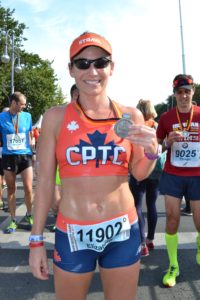
June 2016, after a race. Probably weighing 128-130lbs.

June 2016, after a race. Probably weighing 128-130lbs.

One thing that has been consistent since 2011 – I track my calories and activity. Like a hawk. I measure and weigh most food I prepare. I read serving sizes. I’ve gotten really good at eyeballing food that I don’t prepare. I track it all. I also track all my activity. Not just the training, but sleep, standing and sitting. I know exactly what I’ve consumed/burned per day, the average per week, month and year. That knowledge means I am always accountable. Yes, it helped me to drop to an unhealthy weight/composition in 2011, but it also helped me gain weight back in the form of mostly muscle, and fuel my training needs appropriately. And yes, it means I have to hold myself accountable and enter in all that data, but for my training, goals and general health, it’s worth it.

Now, I found myself taking a hard look at my goals for 2016. My goal for Berlin Marathon (EIGHT weeks away!) is fucking ambitious. So I looked at my data. A hard look. The amount of miles I can safely run per week. The types of workouts. The best way to fit in strength training. And my current body. I stepped on the scale in May, and clocked in my consistent 131lbs. I looked in the mirror and was honest. Not “self loathing, wah I wanna be skinny” assessment, but a purely “how do I do everything I can to be my best” assessment. I decided if I could drop 5lbs. carefully between May and September, losing body fat and minimal muscle, I would be improving my odds for achieving my goal on race day. And so, I have been working for weeks to whittle that number down. This week the scale has read 126lbs. and 125.4lbs. on days where I was well hydrated and fed. Goal achieved! Now I need to maintain that number. There’s a part of me that is eager to take that control of the scale to the next level, and try to drop more. I’ll be carb loaded on marathon day, and that will mean gained weight. But there’s the sane and rational side of me that knows my body and that I need to stay injury-free, and fueled for my training.

My relationship with the scale is rarely healthy or happy for long. Which is why I rarely use it. I’d feel bad when that number went up, or happy and in control when it would hit a new low. Which is silly. And so I usually measure myself by my athletic abilities, and how clothes fit.

I joke and brag about my love for pizza, Chinese food, and Ben and Jerry’s ice cream. I do genuinely love them all. So very much. And I eat all three quite frequently. But I also fuel my body with lots of fresh fruit, veggies, dairy and lean proteins. Those calorically high loves are accounted for and tracked. And I train like a beast. My body doesn’t look or act like it does because I sit on my butt or train sporadically. There is a ton of sacrifice (sleep and a social life), and sweat, tears, frustration and grunt work that goes into what I look like and what I accomplish. I’m a work horse. Plain and simple. What I lack in talent, I make up for with effort. I also have learned to value rest days. Those are the days we are actually rebuilding and getting stronger!

That scale. That number or letter in every article of clothes. They do not define any of us. We often let them drive our motivation, confidence, and our self worth. Often those numbers sabotage us in achieving our goals. But those numbers can change. One way or another. Take that control. Take your body and recognize that you can do anything you want to with it. Anything. It’s pretty fucking incredible. You could train it for anything and everything. Sure, it takes time, sometimes failure, and always hard work – but it’s possible. Once we begin to see our bodies as anything other than the obstacle, the sky is the limit.