How to transition from injured to racing again

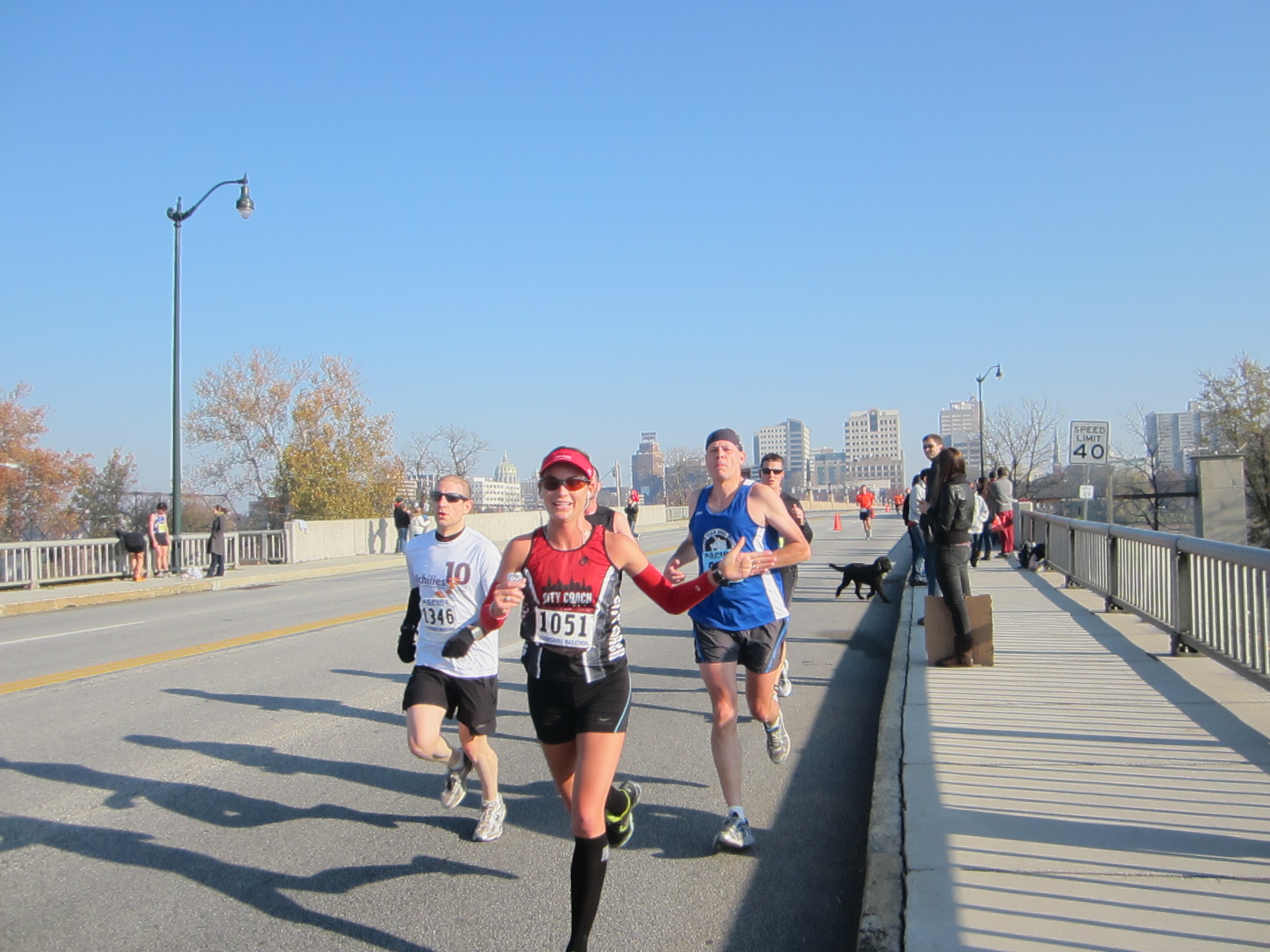
Harrisburg Marathon 2012. En route to a PR until I injured a few miles later. After this race I was forced to stop running for 8 weeks.

Harrisburg Marathon 2012. En route to a PR until I injured a few miles later. After this race I was forced to stop running for 8 weeks.

I was recently requested to write a blog about coming back to training for a goal race after some time off due to injury. I am happy to oblige Miss. Gallagher (girl, you are going to come back stronger than ever!), and think this topic is one that’s all too familiar for runners but also something we often struggle with.

Taking time off from running is rarely a choice runners want to make, but often forced to make at some point in their running careers. A troublesome IT band, tendonitis, stress fractures, torn ligaments – these are the unhappy and always frustrating part of this sport we love. Sadly, there is no magic pill or shoe or weird food we can eat to fix the problem. At the end of the day, the doctor may tell you what none of us want to hear: “REST.” The worst is when we are told “Rest for ________ months.” That’s like a knife to the gut. Being forced to rest many a runner insane. Personally, I become a monster to deal with. I am unhappy, restless, convince myself everyday that I am going to lose all fitness, and will never be as fast or strong as I once was, that my life is over, so on and so forth. The pity party can last for a few days or a few months, depending on the person and how many races or beautiful running days pass them by.

Then, like a child on Christmas morning, you will finally be given the green light – you are clear to run again! YESSSSSS!!!!!!! This is perhaps the best mood you’ll be in since your injury, and rightly so! You can finally take the first steps towards being a runner again. Best. Day. Ever. That is until you are told you need to build your mileage slowly and safely. No jumping into a fast 10K run around Central Park. Nope. Instead you may be told you can start with 10-15 mile WEEKS. Physically, 10-15 mile weeks may shockingly feel tough. Mentally, you’ll be happy to be out running, but feel ridiculous running so little if you were perviously a mileage junky. The struggle most of us have is being patient and smart after we are given the green light. Mentally, we see ourselves at our peak performance and don’t understand or easily accept that no, you are not there right now – though with time and smart training you can be again.

Last year, I was in this very boat and it sucked. I went from 60-80 mile weeks down to 10-15 mile weeks after an 8-week hiatus. Coming back was awful. Mentally, I was frustrated on almost every post-hiatus run. I would go on team runs, and struggle and turn blue at a pace that months earlier was my conversational pace, while everyone else flew by with ease. They were incredibly encouraging, but in my own head I was really hard on myself. Still, those 10-mile weeks turned into 50-mile weeks over time. I reminded myself over and over that I was not going to be injured that year, and that was the ultimate goal. After all, running poorly was far better than not being allowed to run at all. So yes, if you are coming back from an injury, I can totally relate. I can sympathize, and I can be the voice of reason for how and while coming back slowly is the only shot you’ll have of a healthy season.

The important thing is to not compare yourself and your current fitness to the people around you. Hopefully they are not also coming back from injury, so why compare yourself to a healthy runner? In fact, why compare yourself at all? Instead, look back over your past training history, because the evidence for what went wrong and lead you to being injured may be there. Mistakes are welcomed lessons to runners as long as we learn from them. Figure out what perhaps you did wrong. The hard part is being objective. What may be right for your training buddy could be wrong for you. Did you take rest days? Were they really rest days, or were you “not running” but still training in some way? Did you get much sleep? Did you never stretch? Did you wear awful shoes when not running? Did you take on too much mileage or intensity too soon? Did you race every weekend? Do you have physical limitations you pushed too hard? I promise you that your training past has some clues for what went wrong.

Its easy to be mentally restless when coming back to training, especially if you have a goal race looming in the future. I get it, you want to play catchup. Don’t. Instead, come up with a sensible plan. Lay it out in front of you, so you can visualize your time and how to wisely use it. This will reduce any anxiety over a race goal and give you time to focus on base mileage and building back to where you need to be before pushing pace and distance.

Last year, I was given the green light for my first 10-15 mile week on January 8th. I had the Boston Marathon on my calendar for April 15th. Three months to train for a marathon isn’t a lot of time if you are starting with great base mileage. I was starting at zero. Literally. I made it to the Boston Marathon, but I was forced to make adjustments. My race goal had to be to finish, and to run it easy. I was not allowed to run hard. My doctor also didn’t let me run anything fast until mid-March. I ran one 20-miler in my training, while I usually run 3-5 long runs of 20+ miles leading up to a marathon. It was a hard pill to swallow, especially because my original plan was to race Boston and go for a big PR. However, I felt incredibly lucky on April 15th to feel strong and to cover 26.2 miles a few short months after being side-lined. It may happen to you, that your goals get crushed. It’s hard, but remind yourself that once you get healthy and back to racing, there are always future marathons or races. Maybe this won’t be “your year,” but there is always next year – as long as you take care of yourself. As for me, my big PR happened six months after Boston, at the Philly Marathon. Again, you can always adjust and when the timing is right it will happen for you. Be kind to yourself.

When coming back to racing, use support from runners around you. The odds are that many of them have experience with injuries. Lean on them for support. Just be careful to not let them tempt you with running too far or fast too soon. Join them for mileage, but hop in or out of the run as you need to. This will make you part of your running community without doing too much. Communicate with your running pals about your limited mileage or speed. They will be supportive. Again, they have probably been there before.

Lastly, remind yourself that these struggles will make you are stronger and smarter runner in the big picture. Force yourself to learn from your mistakes and your running career can last decades. And if you think the speedy lady in the park who can clock 80+ mile weeks year after year won’t get injured at some point, guess again. Odds are she will. Its part of our sport. At some point we are all that runner starting at zero. The trick is the lessen the odds of being that runner time and time again.


Supplementation Slap-Down

0120bwebRecently the topic of supplementation came up on a running forum, and it sparked the desire to discuss the topic here on Coach Corky Runs. Supplementation refers to vitamins and minerals, and meal replacements  – like protein shakes. These fitness tools have been popular in the health and fitness world, from body builders to people with iron or calcium deficiency.

While some people may benefit from supplementation, be it for athletic performance or daily health, its important to talk to a doctor and/or nutritionist before buying everything on the shelf at GNC.

A few things to consider if you are interested in supplementation: If you eat a balanced diet, you most-likely won’t need any supplements. The exception, of course, is if tests show you are deficient in specific nutrient.

If you are new to a fitness routine, supplementation is not a magic way to become fitter, faster or stronger. Yes, protein supplements can help folks looking to gain weight, but that’s because protein post-workout is a necessary part of the weight-training and muscle building process. Eating chicken, greek yogurt, eggs – anything high in protein will do the job. If supplementation makes getting your protein in post-workout easier than reaching for real food, it is certainly far better than nothing at all. However, look at the ingredients on the package and take note of how many ingredients you don’t know about – let alone can pronounce.

Supplementation without the guidance of a doctor or nutrition expert can be dangerous. Our bodies are all different, and we all need different things. If you don’t know exactly how much of one mineral, for example, you need, you could easily overdose and hurt your body. While many people are anemic, overdosing in iron can be dangerous. Making assumptions without medical reason can get you in trouble.

There are many theories floating around out there that certain supplements can help you train harder, run faster, lift heavier, etc. But these are only theories, have spun into a pretty web by companies looking to promote their supplementation or folks on tv looking to share a miracle vitamin, mineral, or food.

In short, remember to do your research – medical journals, not what’s floating around on Buzzfeed. And talk to a doctor. After all, unless you specialize in this field, you could be playing Russian Roulette with your health and athletic performance.

New Website and New Offerings

img_6984-editGreetings runners and fitness enthusiasts! As you can see, “Coach Corky Runs” got something of a face-lift over the weekend. I hope you like the new website. A few more things will be added and changed in the next week or so. Feel free to bop around it and give me some feedback. Something you want me to add? Something that’s hard to find? Something you love? I welcome your comments!

I’m planning to add more to my “resources” tab, with links to sports doctors, massage therapists, local running stores, etc. So if YOU offer a service geared toward athletes, send me an email and we can talk about adding your link to my “resources” page!

A tab with links to all of my publications will be added.

I’ll be adding more “news” about my own upcoming goals and training, fitness modeling work, and my clients’ recent achievements!

As Spring is finally starting to slowly show her face here in NYC, Coach Corky is offering group classes! For more info, see the tab at the bottom of the page. I don’t know about you, but I am REALLY excited about that one!

You can also anticipate a few guest blog entries from one of my runners, as she’s preparing for her first marathon! I know she has a lot to share, and unlike many of my athletes, she lives 1500 miles away! She also happens to be my little sister. I think her perspective on running, things she’s learned and tips she can share will be especially beneficial for newbies and folks thinking about their first marathon! I am incredibly proud of how far she’s come in the last year of running, and she hasn’t even hit the marathon starting line yet.

I am *hoping* to start working on a book – but don’t hold me to it. I’m so busy running around that it might not be finished for a few years. I am also thinking about working on a podcast or weekly/biweekly vlogs. I’d love to share more info with all of you, and have on some amazing guest speakers!

Happy running!

Coach Corky

Winter Woes and Ultra Training

Back on February 14th, I signed up for the Back on My Feet Ultra Marathon. It was my intention to post weekly vlogs, updating on progress, covering tips for training, thoughts, failures and successes. Sadly, I have yet to take out the video camera. While I am hoping to share some video documentation along the way, I figured I should at least sit down and update you on what has been going on thus far. it is my intention to sit down with the camera soon, I promise.

Boy do I wish I were running here right now! St. Thomas, and I ran on this beach back in August.

Boy do I wish I were running here right now! St. Thomas, and I ran on this beach back in August.

The last month has been insane. Weather has been anything but kind this Winter. While I have been out there day after day with my athletes, running beside them, I have had little motivation to go out on days I am not coaching and clock additional miles. Some of my decisions were safety-related, as the amount of snow, slush and ice on the streets and sidewalks of NYC has been awful many times, and black ice is a nasty beast. I will also confess that I have felt slightly “down” and uninspired to work hard on my own goals.

Another difficulty has been my pacing load. I love my runners, and I am happy to be out there running next to them – even when it’s 5 degrees. I am so proud of my warriors who have hit the streets, day after day in this awful weather. The struggle for me has been that all of the miles tend to bundle within 4 days per week – which obviously is tiring, but also potentially dangerous. I need to make sure I avoid injury, and cramming 50-60 miles within 4 days is a lot for me right now. Therefore, I tend to take the remaining days of the week to rest, because I feel beat up. I need to be more assertive, and move around my coaching to protect myself.

Lastly, my health has been an issue. The last two weeks I have been fighting a terrible chest cold that just won’t quit. It has made it difficult to pace, as my chest often feels tight and I begin to feel light-headed and my legs feel heavy. I am currently finishing a round of antibiotics, and was prescribed an inhaler and nasal spray to help me get over this bug. Not only have I barely run the last two weeks, but I didn’t want to put myself on camera for a vlog while congested, coughing, and blowing my nose. Blah.

I am not worried about my training, because I know I have lots of time between now and July. Right now my focus is on my runners and their goals, and getting healthy. I am excited about daylight savings time, as that should now help a bit with motivation.

I suppose a lesson I have learned and can share with the class is this: the terrible Winter has been grinding at my gears too. You are not alone if you feel unmotivated, frustrated, and simply annoyed with this weather. I feel it too. I am pissed that every single track in NYC has been snow-covered for MONTHS, and that the bridle path in Central Park has also been a slick, snow-covered mess for so much of the Winter season. But I tell myself that this too shall pass, and to relax and just do the best I can until Spring arrives – whenever that will happen.

Tackling Track Etiquette, Rules, and Benefits

Coach086-460x306Running coaches and experienced runners have a few weapons of choice for improving running. Luckily, some of these tools benefit all runners, veteran and novice alike. One of my favorite weapons of choice: track work.

Okay, so you may be assuming that only track athletes belong on the track. You know who they are. They are strong, powerful and confident. They make many of us look and feel like tortoises. You might think if you aren’t a sprinter that there is no reason to ever set foot on a track. You may not even know how to use a track, or wonder about track etiquette. Never fear, I have some basic track rules, tips, reasons why you should use the track, and more!

Regardless of running experience, reasons you run, or race goals (if any), running fast once per week benefits all runners. Running hard calls to action fast-twitch muscles, spikes metabolism, increases cardiovascular strength, and often improves running form. Running fast is also FUN. Yes, its hard, but feeling like you are flying, even if the track athlete next to you whizzes by with ease, will make you feel accomplished, strong, and badass at the end of your workout. Plus, over time you will see incredible improvement in running performance in every road distance from the mile to the marathon.

Hopefully I have peaked your curiosity, and you now want to know any rules for using the track. Great. Here are some basic tips:

  • Run counter-clockwise. Everyone on the track should be going in the same direction.
  • Share the space.
  • Most outdoor tracks are 400 meters once around, if run in Lane 1. Many indoor tracks are 200 meters.
  • Lane 1 (the inner lane), is often the speed lane. If you are running hard, feel free to hop in lane 1. If you are taking a recovery lap, warming up, or cooling down, be courteous and move into the outer-most lane. Just be sure to check over your shoulder before changing lanes.
  • If you are in Lane 1 and need to pass a runner who is also in Lane 1, you can choose to go around them by cutting into Lane 2, or you can try to stay in Lane 1 and yell “Lane 1″ or “Track!.” If the runner you are gaining on hears you and knows track etiquette, they will move out of your way and into Lane 2 so that you don’t have to work hard to pass them.
  • If you are in Lane 1 and hear someone shout “Track!” or “Lane 1″ behind you, glance over your shoulder and move out of their way into lane 2 so they can pass you. Then move back into Lane 1.
  • Do not walk or take recovery jogs in Lane 1, as you’ll probably be in the way of someone doing speedy repeats.
  • Do feel free to tell other runners that they look strong.
  • If your track doesn’t have a water fountain, bringing a water bottle and dropping it somewhere along the track is a good solution.
  • Many tracks have restroom facilities. Some may also have lockers.
  • If you prefer to be on the track when it’s least crowded, avoid “after school hours,” when many school teams will be using the track for practice.
  • Most tracks are open to the public. If you use a track on a school campus, look into if there are any hours the track is not open to the public.
  • Do go to the track with a workout plan. Going to the track and winging it will leave you without much focus.

Runners new to track workouts don’t know what they should be doing on the track. I suggest only going to the track once per week, for your speed session. If you go to the track for all of your training, you will feel like a mindless hamster. You will also fall into a rut. Keep the track for those hard workouts, where you leave all distractions behind and simply focus on the track.

As a coach, I tailor my track workouts to my runners and their race goals. However, you can certainly make up your own workouts! Some popular track workouts: 8X400, 8X800, 4X1200, 3X1600 – you can mix and match and combine all kinds of variations. A general guideline: if your goal is speed and shorter distances (for example, a 5K race), 400s are a great distance for repeats. If you are gearing up for a Half Marathon or Marathon, 800s-1600s will benefit your training.

What the above examples mean in non-track terms: 8X400 @ 5K race pace = run 400 meter repeats 8 times at your goal 5K race pace, with a recovery between each repeat. The recovery times are up to you, but it’s usually beneficial to recover for half the distance of the repeat (in this case, 200 meters), at a SUPER easy jog.

Or say you decide to run 2X400, 2X1200, 2X400 @10K race pace in a workout – that would mean you’d recover with 200s between the 400 repeats, and 600s between the 1200 repeats. Once again, you can mix and match as you choose, depending on your strengths, weaknesses, and goals.

It’s always important to warmup and cool down when hitting the track. While running hard is fun and great for your training, you need to be careful and make sure to not go from 0-60 without waking up your legs. Take your warmup and cool down at super easy paces, in the outside lane.

If you are still intimidated to try out the track, bring a running buddy. Not only will your nerves calm, but you will both probably work harder if you are running together and pushing each other. So find a buddy, bite the bullet, and head to your local track. You’ll realize after your first workout that it really isn’t so scary, and its a training weapon that just might lead to some big person bests this season!