
Boston Marathon – What Weather?

Boston Marathon, 2015.

Boston Marathon. For many runners, it is essentially the magic unicorn of marathon running. For many runners, qualifying is a goal. It takes some of us numerous attempts, years of hard work, and some soul-crushing attempts. But there is nothing like Boston. Once you’ve stamped that qualifier, you are in for one epic ride. There are few things that compare to the feeling of being in your corral in Hopkinton. Being around thousands of other runners who all met a time standard, whether on first attempt or 10th – the energy at the starting line is something unique.

As I sit on my Amtrak ride up to Boston for my 5th attempt from Hopkinton to Boylston Street, preparing for what will be perhaps the worst weather I have yet to trek 26.2 miles through, I am filled with peace. No nerves. No negativity about the weather. If I’d planned to really race my best tomorrow, I’d be a stressed out mess. But each marathon has taught me something new about myself and the sport. With this being my 18th (or 19th?) marathon, I have learned to accept the things I cannot control and to instead focus on the things I can. Bad weather is part of marathons. It’s a big part of Boston Marathon. These less-than-ideal days make the good days that much more rewarding when they happen.

I’ve probably stalked the forecast a good 100 times in the last week. No joke. But I keep reminding myself that no matter how much rain or headwind we have tomorrow, it’s better (and probably safer) than a hot and sunny Patriots Day. No matter the weather, this is Boston Marathon. I’ll be out there in good company with other strong and accomplished marathoners. The best marathoners in the world will be leading the way. The crowds will still be strong, cheering on and celebrating, because it’s Boston.

If you are running tomorrow and freaking out (a natural reaction – especially if it’s your first Boston!) here are a few tips:

  • Don’t fight the wind. Don’t fight the wind. DON’T FIGHT THE WIND. Instead, LISTEN to your body and exertion, and draft behind a group of taller runners whenever possible.
  • Don’t go out too hard. Boston is a pretty fast course. The biggest challenge is the Newton Hills (mile 17-21.) Don’t be scared of the Newton Hills. There are downs to counter the ups. But they are at a tough place in the marathon. The first half of the course is pretty fast, and it’s tempting to go out hard and “bank” time. Try to resist that urge. You risk hitting those hills with quads that are tanked from the downhills.
  • Do stay warm and dry pre-race. Use the tents in Athlete’s Village. Bring layers. Bring plastic bags. You lose energy shivering and try to stay warm. You want your energy for your 26.2 mile journey.
  • Do still hydrate early and often on the race course. Despite cool and wet conditions, you’ll still be sweating and burning up your glycogen storage.
  • Do take in the energy from the spectators. Give high fives, cheer, hoot and holler! It’s BOSTON MARATHON!!!! Make the most of this experience. You’ll make memories no matter what. Choose to make them good ones.
  • If Boston IS your goal race, don’t lose hope that the PR is out of the cards. Yes, the odds are sadly not great. But you know your training. You know what you’ve trained through. You know your strengths and weaknesses. Just go to the starting line at peace with a few backup goals, just in case the wind is too much.

For many of us marathoners, this unicorn is the height of our marathon racing in a few ways. Aside from a few marathons that offer some perks for speedy qualifying standards, most of us are never going to make it to Olympic Trials. Boston is the “reach” goal. It’s special. It’s a race that should be saved for that BQ (my opinion) and then means so damn much once it’s achieved. No matter the weather, tomorrow will be a day. An opportunity. So we’ll get a little wet and run into some gnarly wind for a couple of hours. I can find few better ways to spend a Monday.

Springing into Action

It’s the time of year where many runners who hibernate during the dark and cold Winter months take their first few miles of the year. It’s also the time of the year for Newbies! Perhaps inspiration from a friend or family member, a stress in life is forcing a change, something has sparked the interest in the sport – new runners are testing out their running legs. If you’re new and flirting with the idea of running, or you’re coming back from a serious hiatus, here are some tips and tricks for getting started.

  • Check your shoes. If they are over 6 months old, you’ve used them for walks or time in the gym, or they don’t feel supportive or fresh anymore, get a new pair! Your feet are important. There is no “magic” shoe. Just see what feels right to you. Most decent running shoes will run you about $85-150.00.
  • Start where you are! It can be humbling for the first run ever, or the first run back after some time off. Aim for 20-30 minutes out there. Maybe it can’t all be a run. Maybe it can. No matter what, go at an easy/moderate effort. It’s important to ease into the sport.
  • Avoid cotton socks. Blisters can plague runners, but cotton socks are usually a leading variable. Running socks are a bit more expensive, but worth the investment.
  • Lots of runners want to know their data – how far they went, how fast, elevation, calories burned, heart rate, and so on. If that sounds of interest, I’d recommend investing in a running watch. You can find gadgets between $100-700.00 – depending on how high-tech you want to get. There are also a dozen or two apps you can download on your phone. I find the apps to be less accurate, but it’s a cost effective place to start – especially if you don’t know what your relationship with running will be.
  • Recruit a running buddy to help with accountability and reduce pressure in speed or distance. Focus on simply making running a consistent part of your life for 3-12 weeks. Run with a furry friend, push the stroller, simply build a habit and allow your body to slowly adapt.
  • Don’t compare yourself with anyone else. Your journey with running will be uniquely yours. Your paces, body, mental capacity, preference in route and weather – embrace all of it and own it.
  • Set realistic goals and expectations without dismissing your potential. It’s important to accept where we are at that time. For example, signing up for a marathon 18 weeks out from the 1st run of your life or in months is not advisable. But is a marathon 12 months from now? Sure! And can a 5K or 10K be a realistic and attainable goal in 18 weeks? Definitely. The same could be true with setting the goal of running without stopping around Central Park – for example. But can you run to Battery Park from Riverdale? That’s a bigger goal and realistically would take more time. The sky can be the limit, but maybe not by tomorrow.
  • If your schedule is stressful, add your runs to your calendar. Make gym dates to stretch, cross train or weight train. If you know you’ll be most successful at consistency if you run before work, plan to always run in the morning and start your day off right. If you thrive on a lunch time run, lace up and get in that afternoon sunshine. Set yourself up for success. Reduce obstacles.
  • Accept that your running journey can change and adapt. This doesn’t have to be a serious sport. It can be fun, a stress reliever, or whatever it is you want. It can be a lone experience or a social activity. It can be incredibly competitive and driven. Make it yours!

Tips for Handling the Not-so-Good Races

Races that go well and exceed every expectation make running feel so incredibly liberating. They are satisfying, empowering and simply fun. It’s these races that usually motivate us to keep signing up and racing.

But what about the races that don’t go well? The ones that fail to meet expectations? Sometimes they are a fluke. Other times they are an indicator of other things. It’s important to listen to the signals, watch patterns, learn and adapt.

Here are some tips for handling and dissecting a race that fails to meet expectations, and ways to adjust on the race course:

  • If the race is a goal, be sure to taper that week. Catch up on sleep and try to rest legs so they feel fresh for race day. If a taper or rest isn’t possible, know that performance may be compromised in a big way.
  • Weather is a variable we cannot control. Some runners love cold weather. Others do remarkably well in humidity. Be honest with your strengths and weaknesses. It’s wise to choose goal races at times where weather is to your favor.
  • Be realistic about physical capabilities and mental ones. Some days, our bodies are simply not ready. Other days, and these are the hardest to accept, our body is capable but our minds aren’t – or they give up.
  • It’s common for many runners to go out too hard early in a race. This will almost always backfire. If you know that’s your tendency, try to BREAK THAT HABIT. We cannot continue to do the same thing and expect the results to change.
  • When out on the course, and you can tell it won’t be your day, learn to not toss the race. If the A goal or objective isn’t in the cards, find a B goal. For example, yesterday I ran the Ted Corbitt 15K in Central Park. For various reasons, it was not a good day for me. So I decided to set the goal of holding onto Marathon Goal Pace – which humbled me as holding onto 6:50s didn’t feel as easy as I thought it would! But being 6 weeks out post-Frankfurt Marathon, and only 2 speed workouts in that time, I have lost some speed fitness. That’s okay! I had to accept what I had, and then work within those perameters. I didn’t love that, but I had to accept it and work with who I was in that moment.
  • Be honest about your goals, and how tangible they are. This is a tough one. It’s easy to dream big and find that goal time. But how likely is that goal for you? And when? That’s the tough part – honestly assessing potential, the training, the head space and the course. It’s okay to try something and fail! It’s okay to say “okay, I’m not there yet.”
  • On that note, be honest about whether you were truly ready for that goal that day. Our bodies are constantly changing and growing. Just because your running buddy is ready for a breakthrough race, that doesn’t mean you are. Don’t compare yourselves to others. Instead, celebrate those successes your friends or team mates have! Their success doesn’t make you a failure. You are your only competition when thinking about improving.

The good news is that the bad races make the good ones that much sweeter. Truly. Someone who always succeeds begins to forget just how special and amazing it feels. Struggling is normal. It makes you human. But if there are patterns, don’t ignore them – the good and the bad. The good: you’ve been doing something right for yourself in preparation and on the course. The bad: something, or many things, need to change.

Setting Goals, Assessing Weaknesses, and Moving Forward

Last week I posted about the importance of the off season. Today I want to personally share how I handled my off season, and what lessons I learned about myself as an athlete in my latest marathon cycle, and how I’ll plan to make changes in the future. It’s important to understand that our bodies will adapt and change to anything we toss at it – with time, consistency, and a solid combination of work and recovery. It’s always easier to be the coach than the athlete, and I’ve worn both hats for myself for the last few years. While I know my body and my strengths and weaknesses, it’s not without its challenges.
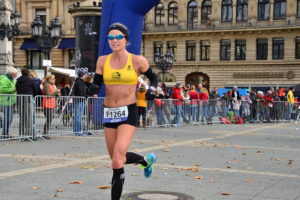
Frankfurt Marathon Training: In Spring I dealt with my first injury in 5 years. I have a heel spur in my left foot that became irritated, and plantar fasciitis stemmed from that heel. They were essentially one big issue. While I ordered special orthotics, put my foot through electrotherapy (not pleasant nor cheap!), and did everything I could, I was also asked to stop running at full body weight. So with Frankfurt, my goal marathon, waiting in the wings on October 29th, I knew the clock was ticking. I ran the entire month of June at 50-80% of my body weight on the Alter-G at Finish Line PT. The monthly membership there was beyond worth it. I was able to run – which I needed physically and mentally. In July, 15 weeks from marathon day, I was given the green light to run outside. I had 15 weeks to go from base mileage on an Alter-G, to chasing down a PR. There were times my foot still hurt leading up to Frankfurt, but at least I knew how to manage it. With a pretty short window of time, I decided to be conservative with mileage. My highest mileage week was maybe 45 miles. My longest run, 20-milers. I supplemented my training with 5-7 hours of weight training per week.

Frankfurt Marathon Reflections: Moving forward, I’d ideally have had a few more weeks of official training, and some time to build solid base mileage outside. That’s my hope for my fall 2018 goal. Also, if I’m honest about my weaknesses, I fell apart late on the course. The weather was tough, and that made me lose my head game. However, my body was capable of more than I accomplished out there – even in those conditions. Therefore, some longer long runs (21-23-milers), and some more negative-split/progressive long runs are what I’ll need to develop a stronger mental space for those late miles. I’ll also plan to increase weekly mileage a bit for next fall. I know I’m not a high mileage athlete, but I think I can add a bit more and still feel healthy and strong.

The Off Season: I’m incredibly disciplined as an athlete. Despite the fun foods I post on IG (and don’t get me wrong – I love all foods!), I also track everything I consume – the good, the bad – I track it all. I’m also disciplined with my training. I can eat a lot because most of the time I burn a lot. I’m training 2 hours per day, on average. That buys me a lot of extra calories. But during the last 4 weeks, I’ve allowed myself to relax. In fact, while in Mexico for a week’s vacation, I didn’t track a single calorie or activity. For the first time in a VERY long time, I gave myself a guilt-free, no rules, do what you want, vacation. I ordered guacamole with everything. I inhaled corn chips like it was my job. I ordered margaritas and buckets of beer without hesitation. It. Was. Fabulous. The month of November had minimal training (some lifting in the gym and minimal mileage), and I tried to really relax, reflect on my training, my accomplishments and my weaknesses, and how to better train and race in 2018.

Moving Forward: So after a training cycle that, despite the bumps along the way, still lead to a marathon PR, I have reflected, rested, and am ready to get back to work. I have no idea how much weight I’ve gained in the last 4 weeks. I refuse to weigh myself right now. I should be focused purely on the training and adapting. Race weight isn’t the focus at this time. But my mind is ready, and my body feels recovered from the marathon – and that’s what’s most important.

My goal race for early 2018 is the Saint and Sinners Half, in Nevada. I ran it last year, set a 6+ minute PR, and won. This year I am going back and hoping to break 1:20. That’s a blazing 6:05 minute mile average. I could NEVER do that on the average half marathon course. But this one is 1200 ft. net downhill, and I run downhill really well. You better believe I’ll be getting my quads and calves ready. I’ll then run Boston Marathon. No goals in time for that right now. I will simply see where my fitness is after the half. I may offer to pace a friend or team mate. I’m not putting any pressure on Boston. Last year I neglected the recovery necessary after the half, and I think that’s what began to cause my foot issues. I won’t make that mistake again. After Boston, I’ll plan for a little off season, and then gear up for a fall 2018 marathon. Right now I’m seriously considering Saint George Marathon. It’s known for its 2000+ net downhill, and being a beautiful course. Again, downhill races aren’t without their challenges. But I know how to train for that and I think that would be a great course for breaking 3 hours. But for now, my eye is on the Half in February. I have 12 weeks.

Advice for You: Above you can see how I’ve handled and structured my goals. As you look towards 2018, space out your goal races in a realistic manner. We cannot do everything. Give your body TIME. Rushing into something, especially a marathon, can be quite risky. Assess your strengths and weaknesses. What should you focus on this year? Put together an organized plan, hire a coach, or find a running club. A clear plan will reduce injury risk and help with motivation and consistency. Lastly, take and embrace the off season. You will come back better.


The Reason for the Off Season

The off season. Most runners are really bad at this. It’s incredibly tempting to cross that goal finish line fired up and ready to dive into the next goal. Even if legs feel great within a day or two of that goal race, it’s important to relax and PAUSE. I completely understand that post-marathon high. I clearly remember days after my first marathon, signing up for two spring marathons with all the enthusiasm in the world. We feel invincible, fired up and inspired. PAUSE. Injury risk is incredibly high within the days/weeks following that goal marathon. Even if you FEEL good, trust that there are things that are broken down and rebuilding. Remember that just like the hard work and the taper, a reverse taper is necessary. The best marathoners in the world take an off season. None of us are the exception. How long or dramatic of an off season an athlete needs will vary. But when in doubt, be conservative.

During your off season, use that post-run high to push you towards recovering and rehabbing any aches and pains. Spend the time to lay out your goals for the following 12 months in a realistic way. Honestly look back over your strengths, weaknesses, and what should perhaps be the focus of your future training. We all have natural talents that translate to running. We also will all have natural weaknesses. The more you know yourself, the better you can train in the future.

Looking towards 2018, I’d advise a few tips for planning:

  • Be aware of any travel you have planned. Out of town weddings, vacations where training may be compromised, etc – honestly factor those things into your calendar for next year. For example, I try to plan vacations where training conditions aren’t completely compromised during marathon training. Certain climates and locations are more or less supportive of training. Can you have gym access? Factor that in now. Or plan that vacation to the islands or with day trips for AFTER that goal race and during your off season.
  • Make sure you budget some recovery into your calendar. Runners want to do everything, and this can be dangerous. Do NOT plan races in back-to-back weekends. Pick and choose. Otherwise injury risk and burnout will at some point occur.
  • Choose races you WANT to do! The options are overwhelming. Think about you and why you want to run a specific race. Is it a fast course? Ideal weather? Scenic? Bucket list destination race? Friends and family want you to do it with them? Do what’s important to YOU, but be realistic. For example, as great as NYC Marathon is, it’s rarely that PR course. So if you want to knock your marathon time down or fight for that BQ, there are FAR better options out there. But if you love that course, then compare previous accomplishments to that course and that course alone.

When you slowly exit your off season (coach is doing that this week after 3 weeks completely off from running – okay, I went for 2 very easy 4-milers in that time), build back carefully. For example, don’t dive into a track workout on your first run back. Ease into things with a week (or weeks!) of easy-effort running. Then you can begin to think about adding intensity. Your body won’t lose everything during the off season. It will bounce back quicker than you think. But stay patient and conservative. Think big picture. And finally, while easing back into those miles, focus on FUN! Embrace a little structure-free running.